Tag Archives: sewing

Function + Sentiment

What constitutes an heirloom?

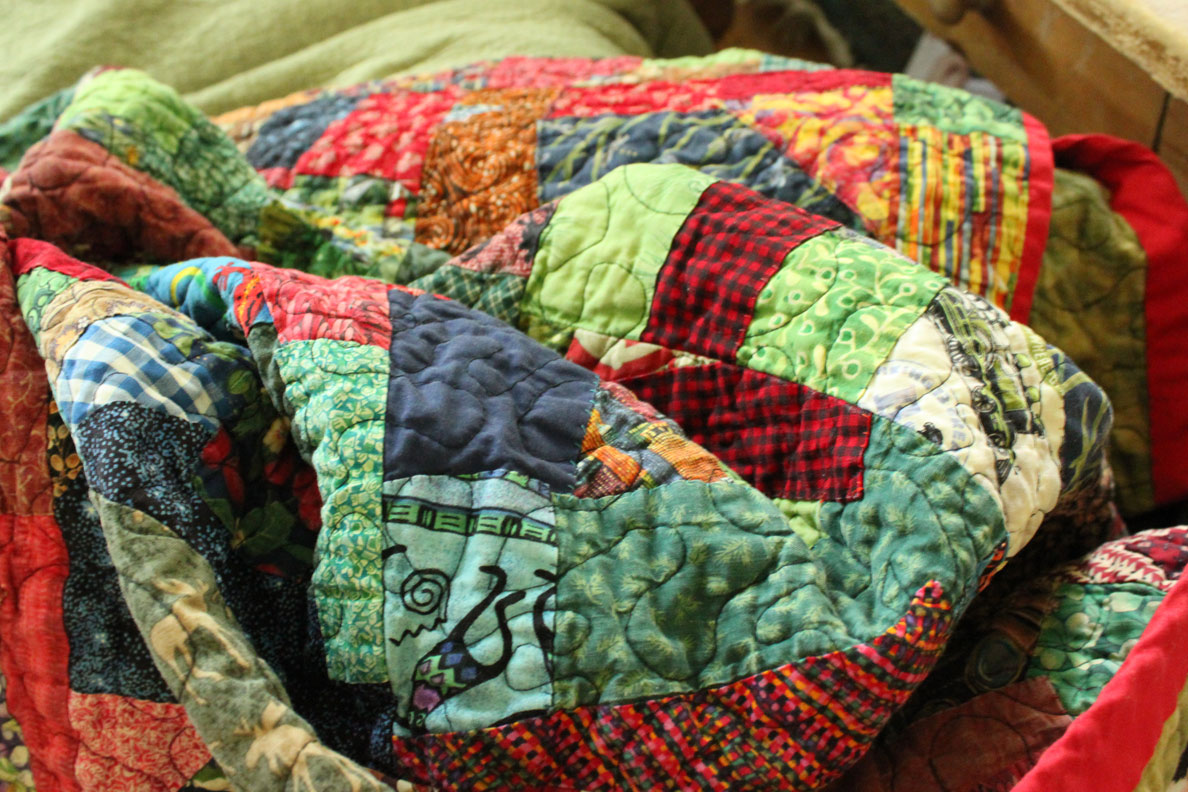
I created this foundation scrap quilt more than a decade ago and it is not particularly well-made.  Nevertheless, it is a precious object.  Why?  Because I made it?  No, not just that.  Because my older son uses it?  Not just that either…

I made it when C. was still a boy – during his elementary school years — and the blanket has been on or near his bed ever since.  I’m happy to report that of the three quilts he could have chosen to take to college, he chose this one (I didn’t make the other two).

Making things for household use is an essential aspect of the quilting tradition – we all know this.  And clearly, sometimes blankets were and are made in the thick of a domestic life crowded with other concerns.  And, while functionality ALONE perhaps shouldn’t render a quilt valuable, maybe usefulness combined with sentiment ought to.

Jude Hill‘s Contemporary Boro class was a wonderful meditation on the value of use.  She went so far as to say, ‘if something has a use but we don’t use it, it’s useless.’  The tendency to have a closet packed with clothes we don’t wear is a symptom of this, isn’t it?

Implicit in Jude’s statement is the converse — ‘if something has a use, and we use it, then it has value’.

I thought about this poorly constructed quilt of C’s in a different way after reading Joe’s recent post (on his blog  ‘manhandled threads‘).  He reflected on a tattered quilt that easily could have been designated a ‘cutter’.  He wrote that he “found this cloth to be filled with a gentle whispering. and, listening to these murmurings, can no longer bring myself to malign its nature further. this cloth deserves love and honor for its own sake. not for what i or anyone else can turn it into.”
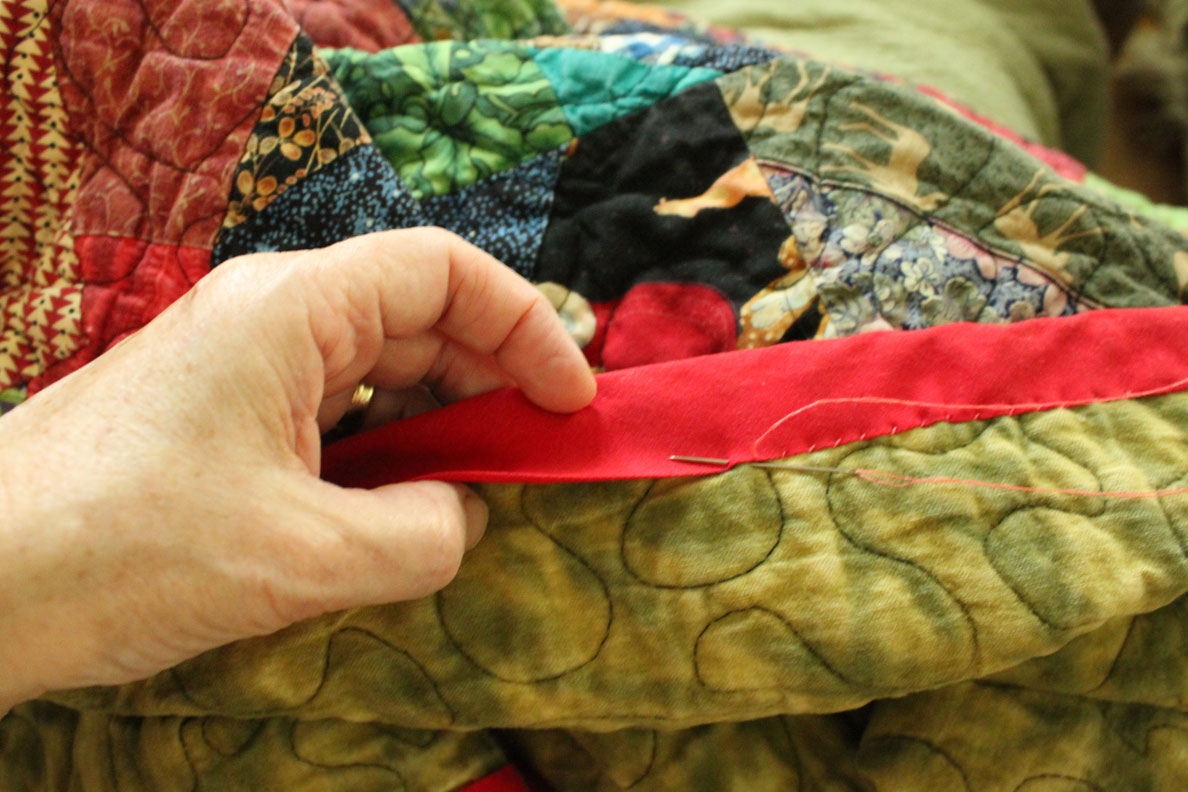
His thoughts were in mind as I selected a slightly contrasting red thread to repair the binding – so as to let the repair show, celebrating the clumsiness of the quilt in a way, and acknowledging that it is a thing that exists in time and is used.  I am not averse to repurposing things, even very valuable linens (see what Karen Ruane does in this regard for truly respectful, inspired use of heirlooms), and yet, I am glad to think that the ‘gentle whisperings’ of this poorly made blanket might give it a certain status.

Have you had cause to look at (and cringe perhaps) an earlier creation? What sorts of thoughts were engendered?

*********************************************
About the quilt:  It is twin-sized and foundation pieced on 48 muslin rectangles… some scraps attached by hand; others by machine; some top-stitched, others not.  Almost all of the fabric came from a friend’s studio up in Maine (if you or anyone you know wears bow-ties, check her out — Lisa Eaton at bowties.com).  She makes wonderful neckwear with holiday prints and other themed-prints, so the patterns were scaled for small scraps and fun for a young boy’s bed.  The 48 rectangles were machine pieced and then I used black thread to quilt with a large stipple (ugh!).  The back is flannel, and the binding a non-bias cut binding.

The learning curve issue is perhaps worth noting here, too.  If I were to make another scrap bed quilt, foundation style or otherwise, I would bring a different expectation and a higher level of skill.  I don’t love making blankets and (not counting crib quilts) have made very few — the size is a challenge both for my work space and my attention span.  But I am gathering fabrics for another blanket for C (my other son already has two), and it will be interesting to see how different my approach and results are from this very early project.

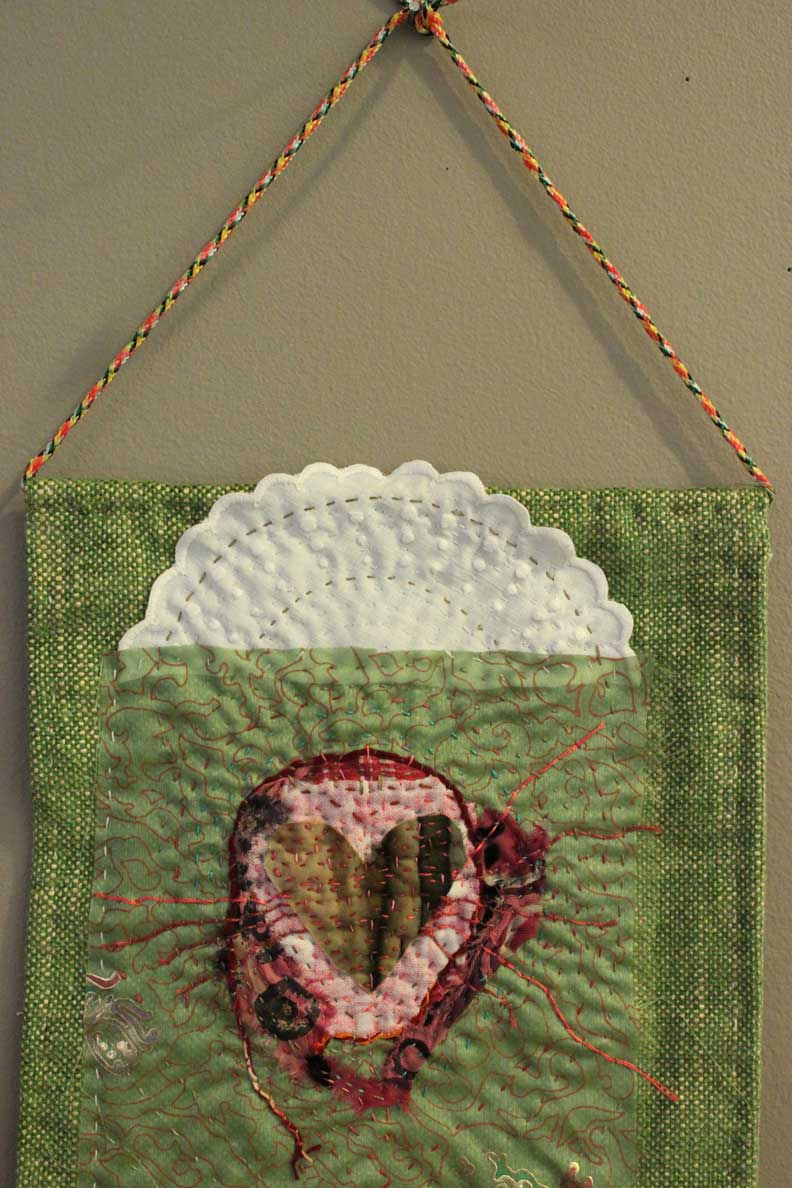
Elegance

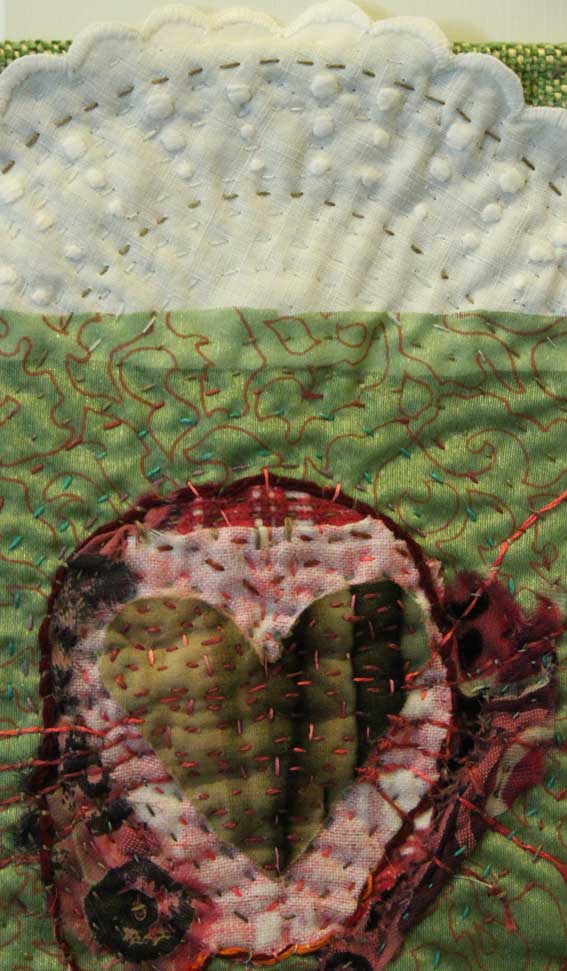
Stitching a hanging rope and a bamboo skewer into the top hem of a little wall quilt feels elegant for some reason.

20120807-140857.jpg

phone picture from last night – sorry it isn’t more crisp

That rope will not slide or tug away, and the skewer will keep the piece (though small and somewhat stiff) from bowing.

I like the way the half-moon vintage doily rises above the top edge.

Part of this effort was inspired by Jude Hill‘s Heart Whispering class.  It is also a continuation of a 12 (or more) year-long exploration of hearts in cloth and thread.  What you can’t quite see in these pictures is that the sheer green Asian fabric features metallic inks.  Yesterday, as the day waned, those gilded areas caught the sun and glowed.

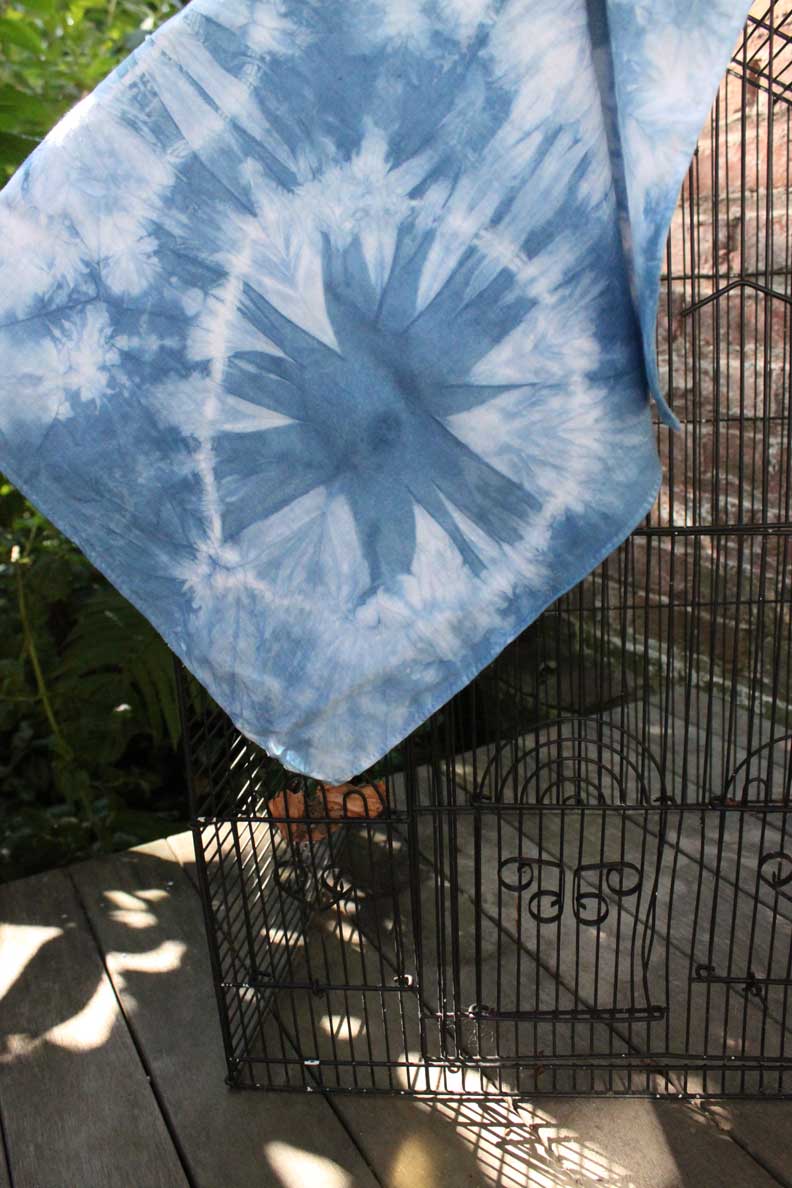
And since I don’t think I’ve posted any pictures of the indigo-dipped cloths that used lacrosse balls as resists, here are a couple of more pictures.

And another.

patchwork to work

This is the chair we bought on Craig’s List a lot of years ago.
It was pretty ratty even then, so you can imagine what ten years of living has done to it.  I won’t qualify that with ‘living with two boys’ because it’s just living that has worn it to a fray, not a particular gender’s style of living (though we will never forget the Sharpie Sleepover incident, which ruined a perfectly good Pottery Barn canvas duck slipcover that had at least another ten years in it, and possibly, (maybe?) was related to the sex of the sharpie owner?)

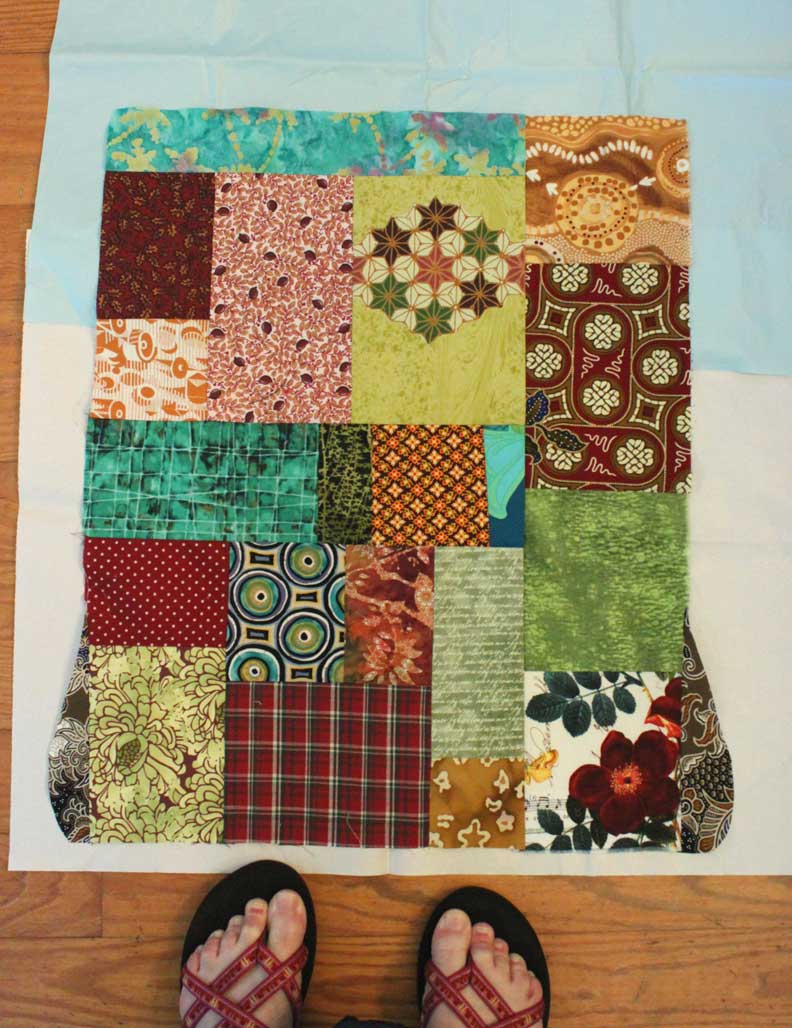
My mother would have made a muslin mock up, stitched the whole thing together, and then taken it apart to use as pattern pieces.  But remember, I am committed to keeping this simple. No muslin patterns. No piping. No zippers.  Here is the near-trapezoid that I pieced for the armchair’s cushion.  It is laid on paper, which will be cut to use as a pattern to cut the fabric for the back of the cushion (which will not be pieced).

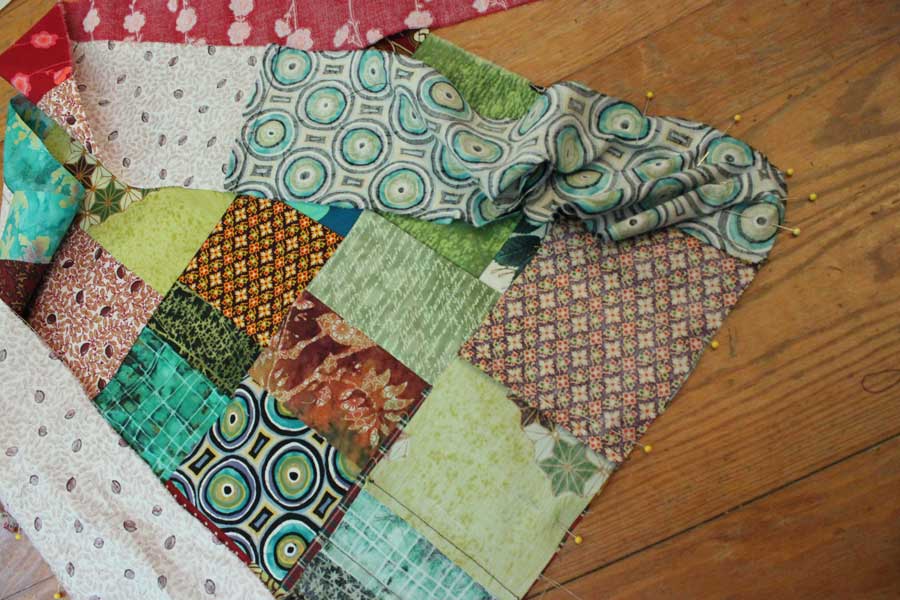
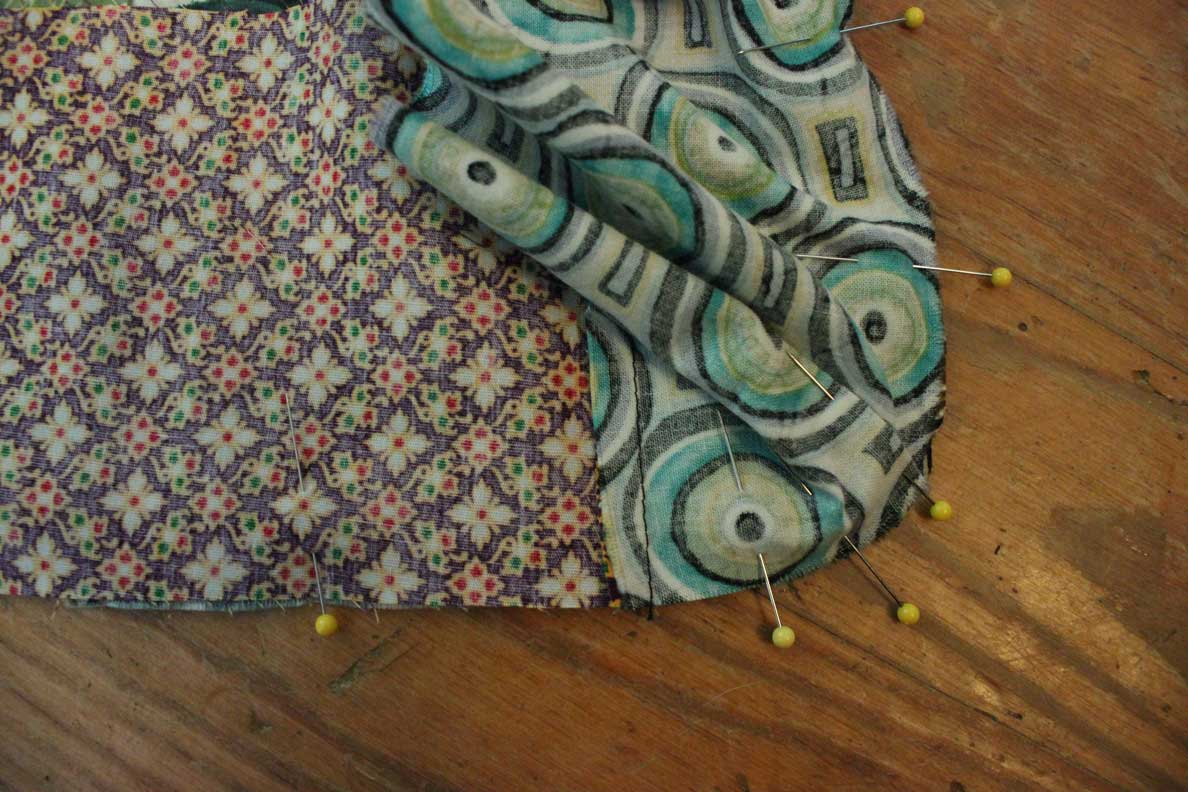
I pieced this section laying the fabric directly on the cushion, which made it very easy for my simple brain to see what kind of allowances I needed, and how the pieced sashing would line up with the top. Here is the sashing, pinned in place.
A small pleat is necessary, even at the curved corners.
The back to the cushion cover will be in two sections, so as to allow the insertion of the seat.
Here is a temporary chair back  — a quilt-in-progress that was folded up nearby.
Although I am open to using pieced sections in ways other than originally intended, I think this one will still be finished as a wall quilt — another installment in the “Global Warming Series”.  I want the back of the chair to use the same fabrics as the cushion.  Given my lack of upholstery experience, these next areas will surely be jerry-rigged!

After snapping the Craig’s List chair picture, I walked into the other room, and saw a “Middle Passage” work-in-progress serving as a temporary chair back.  Happens all the time, and we have all been stuck with pins more than once!

cotton pants

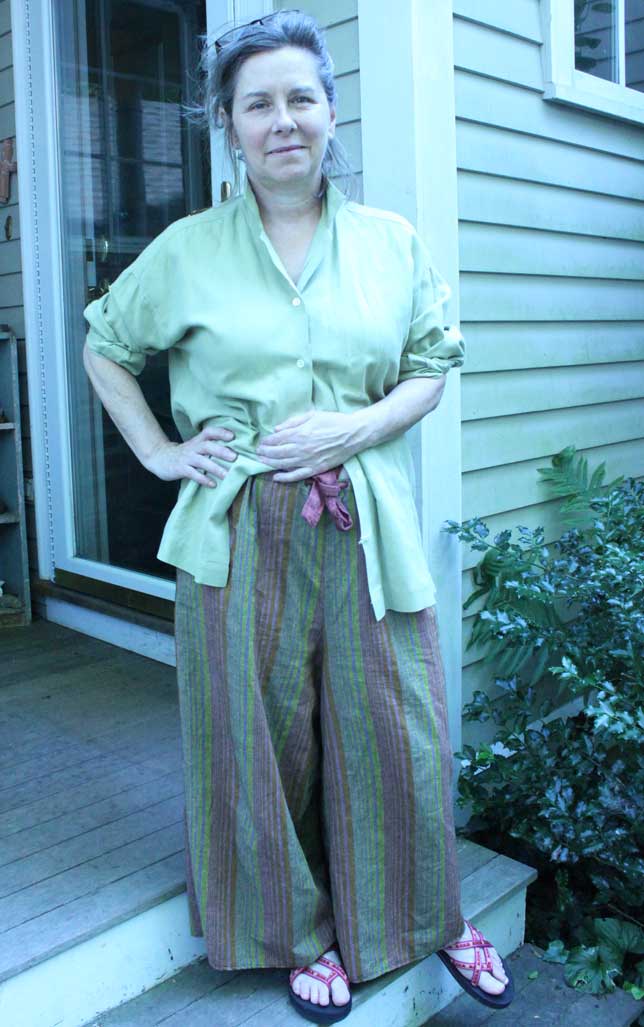
First, there were SEVENTY t-shirts in the duvet cover.  And, quickly, rushing, but as promised, here are the pants I made:

Picture not the best, but you can see the fullness of the leg, the nice drape.  I used leftover sashing from the duvet cover to make the tie.

My one mistake was to sew the casing closed prior to making the buttonholes.  Next time: make buttonholes first! Then sew casing shut.

And, BTW, I had a Linen Bonanza at my favorite thrift store a couple of days ago.  This top was found then.

Now on to other things

The T-shirt “quilt” is done.  It is actually a duvet cover.  This picture shows it empty.  It can work that way.  Or, a comforter could be placed inside.

I am going to count the number of shirts before the hand-off tomorrow.  My guess?  47.  [Try – 70!!!]  It was challenging not just because of the number of shirts, but because their sizes ranged from toddler to teen.  Assembling fifteen or sixteen years of shirts is also, of course, what made it charming.

My advice to Tshirt quilt makers boils down to a few pointers:
1)  Interface right up to the edge of your rectangles (using a presser cloth) (I used fusible midweight);
2) Make sure you know which T-shirts have priority;
3) Make sure customer knows some stains that laundered out will be visible again with heat from iron;
4) For a large, multi-shirt quilt, work in four quadrants;
5) Rather than quilt a queen-sized blanket, consider making a duvet cover;
6) Consider adding some top stitching here and there as you go to further stabilize the patchwork;
7) Get rid of voluminous scraps when delivering quilt (unless you plan to use them for something immediately).

I really am so happy to be working with woven cotton again.  As a treat to myself upon duvet-cover-completion, I made a great pair of cotton pants (pictures tomorrow).  They were a pleasure to make because the material was good quality, ironed well, and didn’t stretch under the needle.  Plus, start to finish, the project took an hour and a half!

Now I am covering one of our raggy chairs with patchwork slipcovers.  Again, working with woven cottons feels so pleasurable after man-handling all that knit!!  My goal with the slipcovers is to let the process be easy (lesson learned in Jude Hill’s boro class).  Anything I create will be a vast improvement on the faded Waverly vines that I have been judging as a mess for many years now.

With both boys gone, the house assumes a different rhythm.  We are eating more lightly, more leftovers, and cleaning up!