Category Archives: Middle Passage

Middle Passage Quilts

This is one of many Middle Passage quilts that I’ve made over the years. I began it a long time ago (2013?) while reading about the transatlantic slave trade but didn’t bind it until last week.

All the usual reasons for delay pertained, prime among them that I am a better starter than finisher. I lose track. Things pile up. But also this: early on a reader of this blog suggested that I was not “staying in my lane.”

All these years later, I say fuck that. Not fuck her, but fuck that. Fuck that. (Cultural appropriation discussed in part here and here and again here).

I will never tell Black women what to think or how to feel, but it certainly matters to me that learning about the history of slavery has made me a more informed, more sensitive person. A better citizen, a better reader of novels, a better writer, a stronger and more informed consumer of American culture and politics.

Before continuing, I have to thank the cadre of readers here, mostly older white women like myself, who have let me know over the years that what I share about American history and race is meaningful to them. It’s not that I set out to teach per se, but by sharing what I’m learning and having you along for the ride, the learning gets amplified and transforms what would otherwise be a solitary process into a communal one. It really matters to me. YOU really matter to me.

I like quilts to stand on their own, leaving interpretations up to the viewer but I thought in this case it might enhance the experience of looking if I were to explain the visual connections between fabric choices and the Middle Passage. So here goes.

The triangular shapes refer to sails. I suppose they could also refer to the triangular shape of the trading routes but I didn’t think of that until just now.

Adapted from History Crunch website

Swatches of indigo, bubble motifs, fish prints, and a black swirly-spiral print call to mind the Atlantic Ocean.

The half-circle black and silver print (at the bottom, above) looks African to me. The black and deep green hand-dyed swatch IS African.

The inclusion of a map print refers to the shores at either end of the Middle Passage — say, Sierra Leone on one side and Charleston on the other.

The brown stripes and the green lozenges both refer to the ship itself. The brown stripe is suggestive of the planks, while the green lozenges call to mind those illustrations that depicted Black bodies packed in the hold below deck.

One reason it’s important to focus on the Middle Passage now and again is because the number of people who died en route is often overlooked when relating the costs of slavery. It’s a huge number.

A conservative estimate puts lives lost en route at 1.8 to 2 million. Another 1.8 million died while housed in the barracoons awaiting transport. Another 1.5 million died during the first year of laboring here.

So one way to look at this is — roughly 14 million Africans were kidnapped to yield 9 million slaves.*

It is hard to wrap one’s mind around these numbers.

My photo from the Lynching Memorial in Montgomery

Check out the Equal Justice Initiative’s website — it highlights, among other things, the lesser known slave-practices and sources of slave-related profit in New England.

Below is another Middle Passage quilt. You’ll notice many of the fabrics are the same.

I’ve linked to these novel-adjacent pages before, but here again is a kind of warm up exercise done in the style of Colum McCann and describing the Middle Passage. It’s called Water Was.

* these figures and the framing of the figures came from a documentary I was watching about a week ago. I tried to back track and figure out what it was. No luck. If I do, I’ll come back with attribution.

Our problematic past

A Memorial to Murdered Jews in Europe is located in Berlin, I learned last week at one of the sessions of the Annual Slave Dwelling Project Conference, and is the size of six or seven football fields. Not only is it huge, but the memorial sits in the middle of the capitol city.

During a Keynote presentation entitled, What Americans Can Learn from Germany’s Racial Reckoning, Susan Neiman asked, can you imagine if a comparable monument existed in Washington DC to memorialize the victims of slavery?

It took fifty years for such a conscious attitude to emerge in Germany, but we’ve had more than four hundred. Only now do the monuments to the Confederacy start to come down. Only now are state flags being revised to eliminate references to chattel slavery.

In Germany, it is illegal to display a swastika. If only confederate flags were equally taboo here (or swastikas, for that matter). If only an Anti-Lynching law could pass in the Senate!

Thanks to Bryan Stevenson, of course, we now have what’s casually referred to as the Lynching Memorial down in Montgomery, Alabama. The National Memorial for Peace and Justice. It goes a long way to recognizing the reign of terror (aka Jim Crow) and its many, many victims. I love the way the project collects soil from the sites of violence for the museum and erects markers at the site of the killings, often with surviving family members present.

The soul jars (an autocorrect for “soil” that I’m gonna let stand) are more akin to another memorial highlighted by scholar Neiman : the Stumbling Stones. These are small, engraved plaques located at the entrance to homes in 1200 cities through Europe and Russia. There are 70,000 in all.

A Guardian article compares the large memorial in central Berlin with these smaller, localized remembrances:

If Eisenman’s large monument, set in the governmental heart of Berlin, emphasises the scale and political culpability of the Holocaust, the Stolpersteine [Stepping Stones] focus on its individual tragedies.

Each stone is engraved with the following: Here Lived — the name of the former resident, their date of birth, and their fate. Some list internment, suicide, or exile, but most of them list deportation and murder.

On this side of the Atlantic, smaller American memorials to the victims of enslavement can be found here and there, with more springing up all the time. While these can never take the place of a national monument, they do matter. I know of at least two.

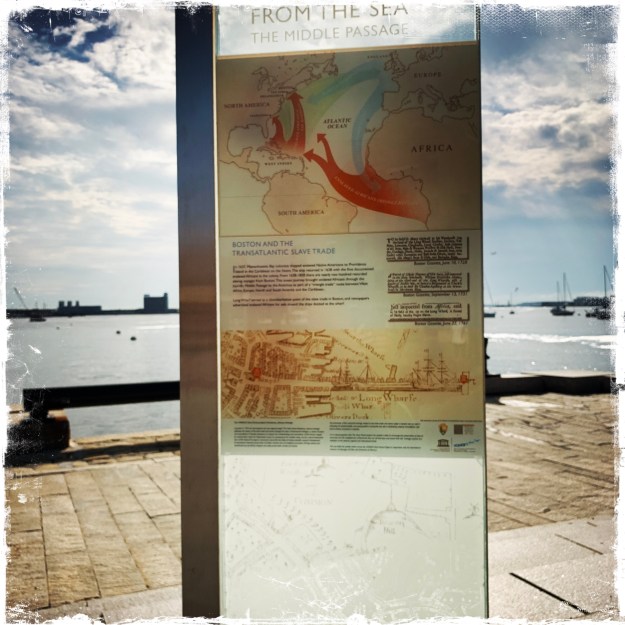
For example, Boston just recently erected a monument honoring those who were kidnapped from Africa and shipped here for sale. I visited The Middle Passage Memorial on Long Wharf and wrote about it here.

There’s also the African Burying Ground in Portsmouth posted about here after a trip to New Hampshire specifically to see it.

The plaque tells us that the male figure represents the first enslaved Africans brought to Portsmouth, while the female figure represents Mother Africa.

But again, let’s contemplate what it would be like if our country had the will, the sense of justice, and the dedication to righting the wrongs of the past such that we created a significant memorial in our Capitol.

It’s unthinkable right now.

I don’t want to end on such a hopeless note, so let me cite a few recent examples of reparations or even, moves toward reparations.

From KQED. One Way To Close The Black Homeownership Gap: Housing As Reparations (full article here):

Cities like Asheville, North Carolina and Evanston, Illinois have taken steps toward reparations in recent months. In Evanston, $10 million collected by the city in cannabis revenue would be used to offer African American residents $25,000 to put toward a down payment on a home.

California just became the first state to sign a law to study and propose a potential reparations plan.

From FiveThirtyEight. Can A Local Reparations Program Undo Decades Of Housing Discrimination:

In the case of Evanston, a suburb of Chicago, the city decided to address its history of discrimination via unfair housing policies, such as “redlining,” a practice in which lenders refused to insure mortgages in and near predominantly Black neighborhoods. So, yes, this is not reparations in the way many people traditionally think of the term — i.e., direct cash payments to Black descendants of enslaved people that attempt to correct the effects of systemic racism — but it’s likely that this program will still take some first steps toward remedying housing inequity.

To end, enjoy a few screen shots.

February 2021

Middle Passage Marker Boston

Labor Day seemed an appropriate day to visit the new display marking the Middle Passage down on Long Wharf, Boston. It is yards from the Atlantic and the site where Africans were unloaded from ships and sold.

I took a lot of pictures, so that I could read later. Why? Parking fees were obscene. I set my timer for 35 minutes, determined not to pay more than $18. But we didn’t really want to pay even that, so we didn’t dally. Made it back in under twenty minutes. High fives at the parking pay kiosk.

Rowes Wharf, approaching Long Wharf

Most of the business along Long Wharf these days is tourism.

Almost all of the marker’s text was devoted to highlighting local luminary African Americans, like Phyllis Wheatley (blogged about here). I expected the narrative to reveal the horrors of the slave trade, so this surprised me a little. Did you know, for example, that the Guinea ships could be smelled from four miles off, so vile was the hygiene and carnage? Or that a loss of life in the neighborhood of ten percent was an acceptable margin in terms of turning a profit?

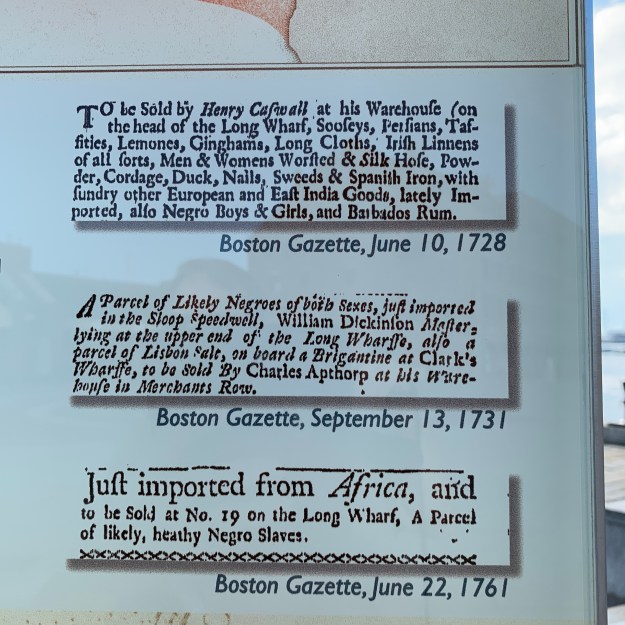
If you read my Facebook post on this yesterday, you’ll have seen the LONG laundry list of ways that the North profited from slavery, pictured below.

Next time we go, I’ll bring flowers and we’ll look for on-street parking.

If nothing else, give

https://www.instagram.com/p/CAqjIBIhu4r/?igshid=1t80u3hwog0iw

It’s heartbreaking that Chawne Kimber had cause to repost her “I can’t breathe” quilt. After nearly every comment, Kimber asked, “but what are you going to DO?” A drumbeat. A call to action. “What are you going TO DO?”

Here is a link to Minnesota Freedom Fund, which among other things, pays criminal bail for those who cannot afford to do so. I gave a little this morning.

And here is a Medium article titled, “75 Things White People Can Do for Racial Justice.” It was written in 2017 and things have only gotten worse since then, so it’s still relevant. You could get lost for years doing the suggested reading and movie viewing. Don’t. Get a parallel course of action going.

Massachusetts has been reforming their criminal justice system in recent years, supported by a number of advocacy groups, like Citizens for Juvenile Justice. I made calls to my reps about some aspects of these efforts back in 2017 and am putting the task front and center again.

In “The New Jim Crow,” Michelle Alexander describes the devastating impacts of mandatory minimum drug sentencing and forfeiture rules. In the case of mandatory minimums, judges lost the power to consider a person’s circumstances. Sentencing that should have been calculated in months was imposed in five and ten year chunks.

When I worked for Aid to Incarcerated Mothers in the 90’s, I met inmates who had received mandatory five year sentences for possession of small amounts of drugs. Drug sales were often motivated by poverty or to support a habit. If parents, these women were almost always in danger of losing custody of their children — a secondary and devastating consequence to ridiculously long prison terms.

Alexander delineates how the forfeiture rules not only created incentives for law enforcement to grab property, it incentivized the vigorous continuation of the drug trade itself.

I’m jumping all around here, but there is a through line.

When making investments, you can either choose a socially responsible fund (an ESG investment) or have an otherwise ordinary fund apply filters. We chose Trillium as our ESG fund and applied the filters of fossil fuels and private prison corporations to others.

Privatization of the prison system creates incentives for keeping incarceration numbers high. More bodies equals more profits. ICE has been housing people in private prisons as well.

While I’m not sure that I fall all the way on the side of prison abolition, I most definitely want the racist and other inhumane policies to undergo reform. Our numbers are beyond shocking.

In closing let me say how gratifying it was to watch Amy Cooper go down in real time. From “twitter do your thing,” to her identity being posted within hours, to her voluntary surrender of her dog before sundown, her termination from Templeton Franklin the next day, and finally, her being banned from Central Park. She went full Donham* and deserved every bit of it.

*Woman who cried rape and effectively killed Emmett Till. She recanted a couple of years ago.

This quilt is from my Middle Passage series.

Water Was — Exercise in imitation of Colum McCann

Water Was

Water was refreshment. A bringer of fish. An instrument of light. A place to strip and ease the skin during blasting afternoon heat. Water was a knee baby’s source of joy. A place to gather and launder cloth.

Now, water was a shark bath, an endless stretch of grey, a bobbing, rocking, and storming transport. The repetitive slap of waves on the boat’s planks during the quieter days, delicate as it was compared to the pounding impact during torrential rain and wind, nevertheless tormented the kidnapped. The holds pulsed with the throbs of welts that puffed and stung where iron cut and abraded.  Joints vibrated in fiery ribbons of pain. Slap. Slap. Slap. Skin went sour with infection. Sick guts released over and over. Lips puffing to cracks. No wonder a slaver could be smelled two leagues off.

River-fresh water was something both less and more than memory.

The rocking made some of them sick. More seaworthy souls were sickened by the sliding puddles of vomit. The defecation corner lasted all of one day and then it was the defecation hold, entire. In a short week and a half, dysentery would cause its floral notes to be squirted into the stew.

How could any man, tall, short, Portuguese, Dutch, English, with or without stripes, turn an entire ocean of water into such a vast jug of indignity?

Jemma vowed to appease his ancestors with blood. Water might serve evil with its trans-Atlantic currents, but he would stand and rise on terra firma. He would stand and rise no matter the contour of the land drawing closer by the sick and sorry day.

Maghalah would be renamed “Maggie”.  The auctioneers couldn’t hear Yoruba in the syllables and the buyers didn’t care. By some stroke of weird fortune, an overseer haloed in red hair atop a face littered with freckles, such a strange sight to many of them, would buy both Maghalah and her mother, renamed “Saffron,” but it would be hard to consider either the girl or her mother lucky by any other measure. Maghalah’s tiny frame would sweat and tremble all the way across the Atlantic to Sullivan’s Island. And after. The torment of the Captain’s violent privilege would not be remembered, but nor would it be forgotten. Trauma gone underground.

When the Passage and quarantine on the barrier isle were finally over, and after their sale and relocation, and during their seasoning, Saffron would comb her daughter’s hair in the pre-dawn hour and rattle on in a low voice about the acacia trees that ringed their village, about the clay along the Niger River, and ask in Yoruban, did her dear sweet girl remember the sound of women pounding cloth at the river, the thumps and the laughter? Saffron worked memory like a defiant muscle. Saffron needed to speak her own tongue. Saffron wanted her daughter to remember, but she no longer recognized what was balm to the soul and what constituted ongoing torture.

Home was not free of suffering, of course, but a natural order prevailed, more or less. Death might strike suddenly and heartlessly, imparting grief and ruin, but there was no one collection of people — not even competing and raiding tribes taking slaves – no one collection of people who had ever so thoroughly robbed another group of people of power and spirit and dignity, and then enforced that lowly status, savagely perpetuating it forward for twelve generations, based solely on skin color.

Though silence would become their primary language when in and among their captors, sometimes the native tongue of one or another would convey something immediate and raw. Such a conveyance might save a life – if the life wanted saving. Or it might express a lyrical sentiment or nuanced observation that their broken English could not. And it mattered, even if only one other bondman in the field understood. Keening in their native language gave comfort in those early years. Even if it was a voice of one or two, instead of the whole assembly, even if three or four languages rose in chorus, even if it was in the dark, fields and fields away from the Big House, where they were consigned to the dank, low spots of the woods, away. Small comfort as those echoes of home were, they would soon be transmuted, blended, and adapted to their new world, and faster than you might think possible.

This style exercise was written a few years ago and edited this morning (2018), done in imitation of the opening section of “Dancer” by Colum McCann.

Though there’s some risk in publishing a couple of pages from my novel-in-progress,”The Weight of Cloth” (formerly called “Blood and Indigo”), I’m doing it anyway, partly because these pages have been rejected from the manuscript. Four of the novel’s characters show up — mother/daughter, the red-haired overseer, and Jemma. Only Jemma is based on a historic figure. He’s one of two figures consistently named in accounts of the Stono Rebellion (9/9/1739). The other is Cato.

All photos taken by me on an iPhone. In order: coffee pot from slave quarters at the Aiken Rhett House in Charleston; window opening and door and final house view from McLeod Plantation on James Island, sweetgrass basket was made by local African-American artisan and purchased at Charleston City Market.