Tag Archives: slavery

Civil Rights Tour #3

Montgomery, Alabama

Statue outside the National Memorial for Peace and Justice

Site of The Legacy Museum and the six -acre National Memorial for Peace and Justice (aka the Lynching Memorial). These were the main reasons for making the trip and they did not disappoint.

Outside the Legacy Museum

Photos were not allowed inside the museum, so I’ve embedded one of their Instagram posts.

The excitement started before we even entered the exhibits. A hubbub. Early — not even 9:30 am — and ticketed entrants spilled out of the foyer, many more waiting outside. I would’ve loved to know where people had traveled from to be there.

The museum is huge and comprehensive, covering the Transatlantic Slave Trade, Jim Crow, the Civil Rights movement, the prison pipeline, and more. Every inch of the museum is designed to appeal to both emotion and intellect, offering the visitor images, text, and audio. Some exhibits were duplicated on both sides of a small space and entries were timed, so you really could take in the displays (or try to). Other exhibits were cavernous, like the area with replicated runaway slave notices stretching 15 feet up and wrapping around stand-alone display walls.

It’s too much to convey here but let me at least describe the entry and first exhibit.

After passing through security, you enter a small dark room with one wall dedicated to a video of the ocean. It’s probably twenty feet tall. The waves are coming at you. Crashing and swelling. You feel a sense of scale — both the enormity of the ocean and the smallness of your body. And then, projected onto the waves you see a few statistics about the slave trade. Numbers of bodies kidnapped. Numbers of lives lost in transit. The scale of the tragedy is almost impossible to take in.

A powerful way to begin.

Next up, right after the waves, probably my favorite space. Again, it’s small and dark. This time water is projected onto the floor. It’s a luminous blue gridded with white light and it washes over the floor and then recedes. Mirrors amplify the effect. On the floor, as if emerging out of the ground or water: clay heads and busts. They are life-sized. Some are in chains, some wear iron-spike collars or ripped tunics. Others are naked. All express agony or bewilderment. Each is distinct and you cannot stop looking at them. The sparkling water washes over them then recedes, illuminating them and then leaving them in darkness. It’s astonishing.

Scattered throughout the interior are viewing rooms. In one room, there was a video about the artist who made these clay forms. Kwame Akoto-Bamfo. He is from Ghana and you can read about his work here.

The outdoor memorial also uses scale to convey the mind-bending levels of violence perpetrated by white people on Black people. The shed is huge. The down-hanging blocks represent counties, with names of known lynching victims etched upon them. They are not organized by state and so you get this dizzying impression of murder being everywhere — an unavoidable and relentless violence.

D is from Georgia and so photographed her county.

Photo by Doris Tennant

The site is not a static memorial. Each block hanging in the shed has a duplicate version stacked up out on the lawn. If a county is prepared to go through a process of public acknowledgement, they can take their block to their county and post a landmark. The plaques below are copies of such acknowledgments. They are not formulaic. I got the impression each was informed by a thorough and deep community process.

Most of the blocks are unclaimed.

Black History, a selection

From The 1619 Project, EPISODE TWO: “Rape was so prevalent during slavery that today 1/4 of the genetic makeup of Black Americans can be traced back to Europe through the paternal line.”

Colonial governments made descent of children of enslaved women matrilineal in order to ensure that any children they bore were slaves (even the mixed race children, say, of their owner).

The episode goes on to examine the lopsided health care that contemporary Black women receive, tying the shameful conditions directly back to slavery.

FACT: Black women die in childbirth at THREE TIMES the rate of white women.

FACT: Black infants die at TWICE the rate of whites babies, a discrepancy that disappears when the OB is Black.

FACTS: Black patients are under-treated for pain, as if there were biological differences between Black and white people. Furthermore, their life expectancies are shorter and they’re often blamed for their health issues.

Slave owners always had an economic interest in the reproduction of their slaves, but after Congress banned the importation of Africans in 1808, it became an even more important way to preserve and build wealth.

In the amazing novel WASH, by Margaret Wrinkle, the white slave owning protagonist hires out the enslaved character named Wash for the purpose of procreation. Keeps meticulous records. Is paid for the “exchange.” One of many poignant moments occurs towards the end when Wash burns that ledger and lets those flames then take a barn down.

I know from my research that in South Carolina in the mid-eighteenth century, slave owners believed that breeding Africans with Native Americans would produce stock better adapted to winters.

Breeding. Stock.

And BTW, another source of wealth for early colonizers as to round up, kidnap, and sell Native Americans to slave markets in the West Indies. Native Americans were not favored as slaves in South Carolina because they had family in the area and knew the landscape better than anyone, heightening the chances of their escape.

A look at racism, part 48

Today’s idiosyncratic tour of racism, reactions to racism, and/or the history of racism swings through a twitter thread.

Yesterday a WW (that’s “white woman” from now on) posted her horror at learning that, at some point, George Washington killed all his slaves’ dogs. Her tweet is circled in yellow below.

Here’s one possible source for this fact — a Frontline episode on PBS.

Even though I’ve read about some of the most horrific forms of torture employed by slave owners and have had to really think about the heartless mercantile interests of slave owners trafficking in Black bodies, I also recoiled at the dog-killing.

Does this mean I care more about dogs than about the enslaved?

Of course not.

I thought Washington’s dog-killing was an extreme and sadistic act meant to deprive his slaves of the comfort and companionship of their pets. The Frontline article though seems confirming of the tweeter’s assertion — that he was acting out of economic self-interest. The dogs were killing his livestock, perhaps?

PBS Frontline

Anyway, I didn’t spend a lot of time reading the comments because I knew the dumping on the WW would, in this instance, bother me. It’s NOT EITHER / OR.

And BTW, sometimes it’s evident that people DO care more about pets than the people involved. Take the aftermath of Hurricane Katrina.

It seemed then that there was a lot of attention paid to the stranded animals and maybe not enough attention paid to the ravages of New Orleans’ largely Black parishes. Also, that the recovery effort was so botched could have been viewed through a lens of racism and generally wasn’t.

Another EITHER / OR that I’m thinking about and will come back to post about sometime soon is: how the fact that race is a scientific fiction across the board (not just for white people, in other words) can coexist with our profound acknowledgment that race as a social construct is profoundly and persistently problematic.

Collages are 2022 creations made to visual prompts from Paris Collage Collective.

Falling apart / gluing together

I have a bunch of collage books. They’re generally not art books but rather something between pattern studies and wish lists for interior design.*

There’s a freedom in cutting and pasting without worrying too much about the results.

I pulled a notebook out yesterday that’s falling apart. This intersection of picture-edge and coil failure is probably my favorite shot from the book.

I used to use rubber cement. It often fails with time. I like the marks it leaves behind too.

You’ll notice some themes: barns and fabric, angels and antique maps of the heavens, flowers. Death and ghosts. Love and more flowers.

The peony/Browning poem with a picture of D as a young boy is a copy from another Sketchbook Project, the one I cannot find on the site. The theme was : Jackets, Blankets, and Sheets.

Rubber cement mark on lower left.

Sometimes the order of the images matters. I like the way the three above relate to each other.

And sometimes (often?), the collages reveal that I was thinking about my novel, like the ones below.

Eliza?

In the period that I wrote about (1737 to 1744), many of the enslaved had just been kidnapped from Africa. They were called “saltwater slaves” or “comyahs” (as opposed to “binyahs”) (say those two words aloud and they’ll make sense). In other words, in the early colonial period, some slaves were born here and some in Africa. I’ve thought a lot about what it would have meant to have memories of home, to have been ripped away from a coherent society and family, to be force marched in coffles, warehoused in disease-ridden pens, and then shipped to these shores — landing into lives of brutality, abject humiliation, and privation.

These geographical and soul wounds can be viewed through the lens of indigo. Eliza Pinckney was an early innovator, but the slaves who harvested, aerated, and acidified the batches of dye may have had very specific memories about the crop, not to mention expertise. I learned about the Tuaregs of the Sahara, also known as “the blue men” for their intense deep indigo blue turbans — cloth which when unwrapped would leave blue shadows across their foreheads. I learned that in some areas of Western Africa cloths were woven with indigo threads to swaddle babies at birth. The same cloths would be worn at weddings and then used as shrouds at the end. Also, I learned that men tended to be the weavers.
Sea Island Indigo workshop, SC. 2014

I could say more about all of this but will leave it here for now.

Image of gate leading out of barracoon, west coast of Africa, plus other images.

* Exceptions: The Sketchbook Projects, collected collages done under Acey’s direction, and two books of Paris Collage Club works (one done, one in progress).

Middle Passage Marker Boston

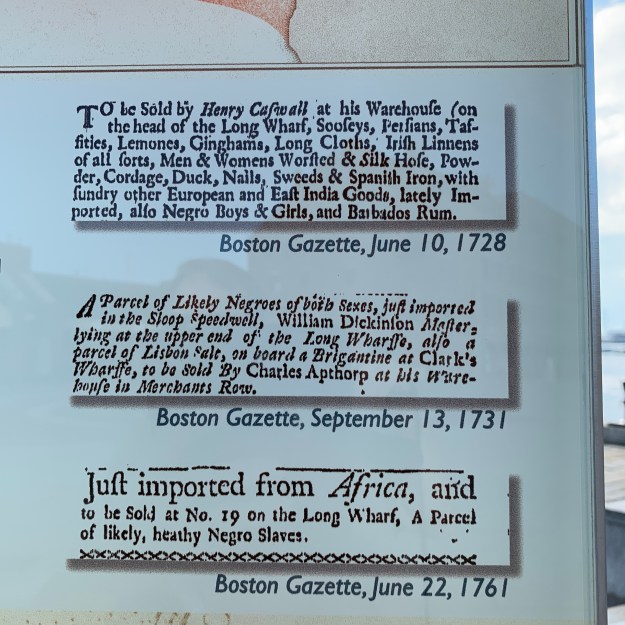
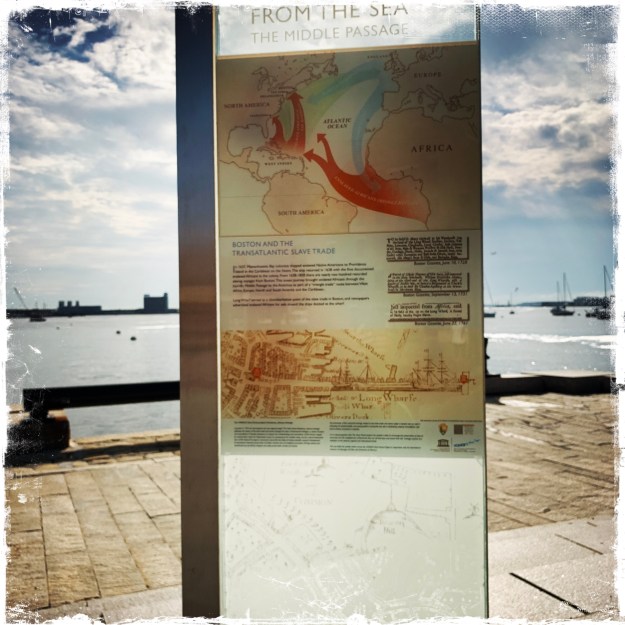
Labor Day seemed an appropriate day to visit the new display marking the Middle Passage down on Long Wharf, Boston. It is yards from the Atlantic and the site where Africans were unloaded from ships and sold.

I took a lot of pictures, so that I could read later. Why? Parking fees were obscene. I set my timer for 35 minutes, determined not to pay more than $18. But we didn’t really want to pay even that, so we didn’t dally. Made it back in under twenty minutes. High fives at the parking pay kiosk.

Rowes Wharf, approaching Long Wharf

Most of the business along Long Wharf these days is tourism.

Almost all of the marker’s text was devoted to highlighting local luminary African Americans, like Phyllis Wheatley (blogged about here). I expected the narrative to reveal the horrors of the slave trade, so this surprised me a little. Did you know, for example, that the Guinea ships could be smelled from four miles off, so vile was the hygiene and carnage? Or that a loss of life in the neighborhood of ten percent was an acceptable margin in terms of turning a profit?

If you read my Facebook post on this yesterday, you’ll have seen the LONG laundry list of ways that the North profited from slavery, pictured below.

Next time we go, I’ll bring flowers and we’ll look for on-street parking.