
 To find one’s voice with cloth is particularly challenging, I think, because there are so many ways to attach scraps to each other and to a flat surface, and then many ways to quilt or otherwise add texture. And while one is busy trying to figure out what techniques fit with one’s temperament and basic work-tempo, there is the perhaps less-tricky but still not-exactly-straight-forward business of finding one’s basic subject matter. It is a challenging braid, this winding of technique and subject, and one that can take a frustratingly long time to come together. Because the learning curve for technique is fairly long, one can hide behind the process of skill-acquisition for undue amounts of time. Then, as a decorative art, quilting affords the possibility of playing with pattern for its own sake, which is not a BAD thing, but is a process that won’t necessarily inch the maker closer to her subjects.
Turning to Brenda Ueland’s little but profound book on writing this morning (“If You Want to Write – A Book about Art, Independence and Spirit”), I found this:
But how to single out your true self, when we are all so many selves? Yes, I know that is hard. I know I have been much puzzled by this, for I myself seem to be so many different people, sometimes a man, sometimes a woman, a murderer, a whiner, a mother, a simpering lady, an old rip, a minister, a burglar, a lion, a weasel. And, all my teaching would go for nothing if, in trying to find your true self, you would begin to strain and cerebrate with an anxious neurasthenic frown: “Am I now writing with the utmost sincerity? I wonder.”
No, you must not do that. They only way to find your true self is by recklessness and freedom. If you feel like a murderer for the time being, write like one. In fact, when you are in a fury it is a wonderful time to write. It will be brilliant, – provided you write about what you are furious at, and not some dutiful literary bilge….
Gradually by writing you will learn more and more to be free, to say all you think; and at the same time you will learn never to lie to yourself, never to pretend and attitudinize. But only by writing and by long, patient, serious work will you find your true self.
Ueland footnotes that last sentence to say ‘or by any other art; or by the use of the creative power.’
I wonder, though. Is it all that possible to quilt ‘murderously’? My question is open-ended and I would love to hear other fiber artists’ thoughts about this…
I have a hunch that piecing and stitching – even furiously fast stitching on a machine – does NOT lend itself to particularly riled up states of being. It may be that those wildly aching, storming states that we all experience from time to time, might very lend themselves to writing or painting but not to quilting.
Could this be why so many fiber artists ALSO draw or write or, or, or…?

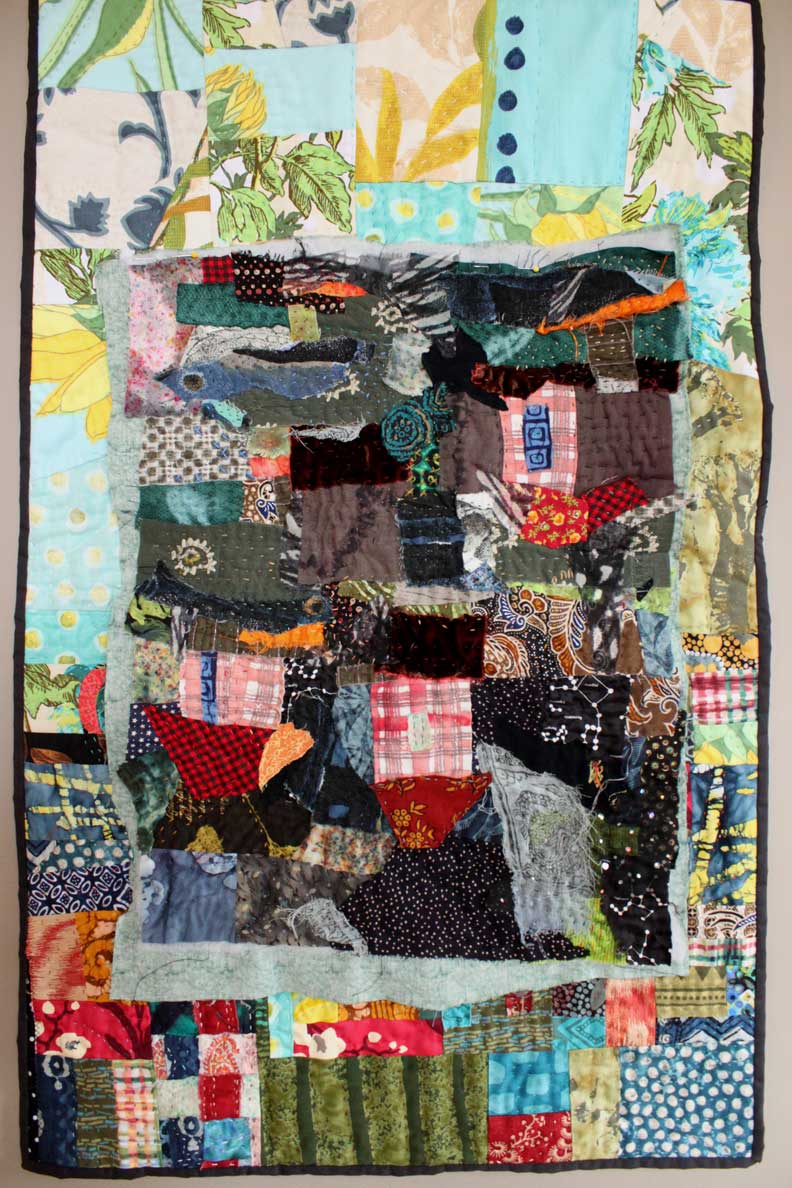
Notes about this WIP and these pictures – I often audition quilts on a quilt that is on the wall. Mostly because it is THERE, but also because if the auditioned piece is smaller, I like the provocative visual of another quilt (and one with perhaps a completely different feel and palette) surrounding the new one… it visually asks, even if one is not initially prone to wonder, does this little insert demand a bigger mantle? Do any of the mismatched colors in the unintentional background, in fact, MATCH?
What was surprising about this particular audition, however, was not the dissonance of old quilt to new quilt, but the fact that I hung the auditioned piece UP-SIDE-DOWN and didn’t even realize it until the next morning. So this time, the question being begged is – should I reverse this piece? Does it demand a horizon or something more like a fore and back ground? Could I reverse it without losing the hut shapes, should I decide to go that way?!
I often remember the basic design principle which says: Good design works in all directions, and sometimes specifically take pictures so that I can turn the piece on my screen and view it rigorously from another angle (obviously you don’t need a camera for this, but something about looking at a picture of a work-in-progress is instructive, as well). But this is not about that.
Fearlessness with quilting, by the way, is often about cutting. Snip, snip.