Tag Archives: american history

Civil Rights Tour # 6 — Selma again

Picture this: a well-heeled white woman standing next to her shiny SUV in front of the artists’ cooperative that we were about to visit. Hear her going on and on about how great Selma is. Well worth more than a single day of your time! We have great churches. We have great synagogues… (huh? One of us is Jewish, but did SHE know that?)

I don’t doubt that Selma is a great place, one that deserved more exploration. We skimmed the surface, in and out in a few hours. We walked over the famous bridge, had lunch, quickly visited two “interpretive centers,” grabbed some ice cream, and were off.

But Selma’s obvious state of decline made me sad. Really sad. It struck me as emblematic of decades of misguided Republican “trickle down economics” and racist policies. Downtown was dead and further out wasn’t better — peppered with shacks, run down apartment complexes, boarded up gas stations.

Maybe the city gleamed before Covid, but I kind of doubt it.

We had lunch. Or tried to. I’ll give this place points for style, for friendliness, and for an earnest effort. But boy was it a miss. The food sucked, I mean really sucked. And we waited and waited for it, even though there was only one other group there.

Across the street: a faded Israeli flag and a neon sign reading: gentle human / thank you for coming.

Alabama River

There were two interpretive centers (that seems to be a new name for museums) — one on one side of the Edmund Pettus Bridge and one on the other. One was compact and polished with well-produced audio-visual presentations and a nice gift shop. The other was folksy, expansive, and more than a little worn at the edges.

The less-polished place started with an introduction by the guy at the front desk. It was elevated speech, nearly oratorical, with much mopping of the brow. Inside, we quickly appreciated the museum’s attempt to honor the “foot soldiers” of the Selma/Montgomery march. There were news clippings affording detail not found in more mainstream reporting, lots of photos, and even plaster casts of some of the protesters’ feet.

I was too tired to avail myself of the many resources at the other interpretive center, although this portrait (below) certainly caught my eye.

Sheriff Jim Clark, known for his violent temper

He looks like a monster, doesn’t he? He’s the reason Selma was chosen as a site for the march to Montgomery. His reactive, racist brutality could be depended upon to make a spectacle.

Finally, before leaving town we visited the “Candy Lady.” The place was almost deserted and the owner thanked us profusely for coming in and buying a few bowls of ice cream. That seemed revealing of two things: one, that she was possibly hurting for business and two, that in casual encounters people in the South are so much nicer than Northerners. By miles. It’s almost disorienting how much nicer Southerners are. Especially given the history.

Dated March 19, 1965. Seen at the museum at the Lorraine Hotel in Memphis

Homage to Harriet Jacobs

stones-and-tree

Mt. Auburn Cemetery, Cambridge, Mass.

Harriet Jacobs was born into slavery in North Carolina in 1813. She managed to free her two children, remain hidden in her own town for seven years (while a vicious relative of her owner relentlessly hunted her), escape to the free states, avoid capture after the Fugitive Slave Act was passed in 1850, make a living, start a school after the Civil War, and somewhere in there, to write a remarkable memoir. Incidents in the Life of a Slave Girl tells the chilling and inspiring account of her life. Here is an excerpt:

Pity me, and pardon me, O virtuous reader! You never knew what it is to be a slave; to be entirely unprotected by law or custom; to have the laws reduce you to the condition of chattel, entirely subject to the will of another. You never exhausted your ingenuity in avoiding the snares, and eluding the power of a hated tyrant; you never shuddered at the sound of his footsteps, and trembled within the hearing of his voice.

Ms. Jacobs was initially owned by a woman who promised to free her. As often happened, however, the promise was not made good and Ms. Jacobs passed through her mistress’s estate to the testator’s three-year-old niece. The niece’s father was a lecher and harassed and pursued Harriet until in a desperate bid for safety she allied herself with a white neighbor. That  neighbor was Samuel Tredwell Sawyer. He would go on to become a U.S. Congressman. At 16, Ms. Jacobs bore him the first of their two children.

may-reads

Spring and summer reading

Afraid that her children would be sold or shipped off to a distant relative of her tormentor, Jacobs ran away. The hope was that Sawyer would buy and free their children. Through an agent, he did purchase them. He did not free them.

Jacobs hid in a garage and then the teeny garrison of her grandmother’s home for a total of seven years. She survived horrible cold and heat, invasive stinging bugs, and near loss of the use of her limbs from being cramped for so long. How she managed to survive defies understanding. Like many bondwomen with children, her concern and longing for those children seemed instrumental in keeping her alive.

mother-daughter

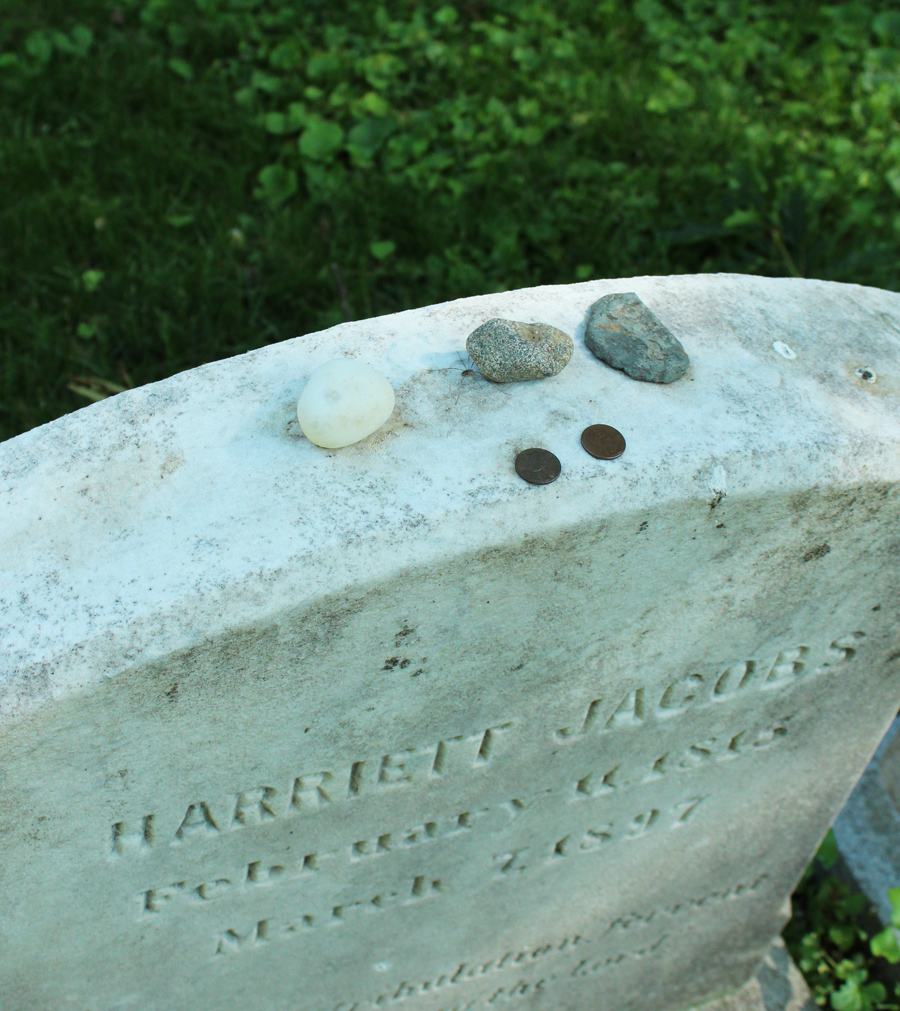
Harriet’s stone is inscribed: “Patient in tribulation, fervent in spirit serving the Lord”

How she escapes, manages to arrange for the freeing of her children, and her encounters in the north are fascinating and important pieces of American history. This slave narrative is provocative, well-written, and horrifying.

Annette Gordon-Reed’s Pulitzer prize-winning book, The Hemingses of Monticello: An American Family, has been a great companion text to Incidents, particularly on the topic of the kinds of calculations and risks an enslaved woman might make in allying herself with a powerful white man (in that case, Sally Hemings and Thomas Jefferson). It is too easy to say, for instance, that Sally Hemings was a complete victim given the agency, albeit limited, that she exercised.

respects

respects

Just as I was finishing the memoir, I learned that Harriet Jacobs was buried in nearby Cambridge, Mass., in the Mt. Auburn Cemetery. Two weeks ago, K and I went to pay our respects. It was the only stone we saw that day with visible tokens carefully placed on its upper edge. Three stones and a penny. Having forgotten the irises that I meant to bring from my garden, I laid another coin above her name.

* The book spells ‘Harriet’ with one ‘t’. Obviously, her gravestone spells her name with two.