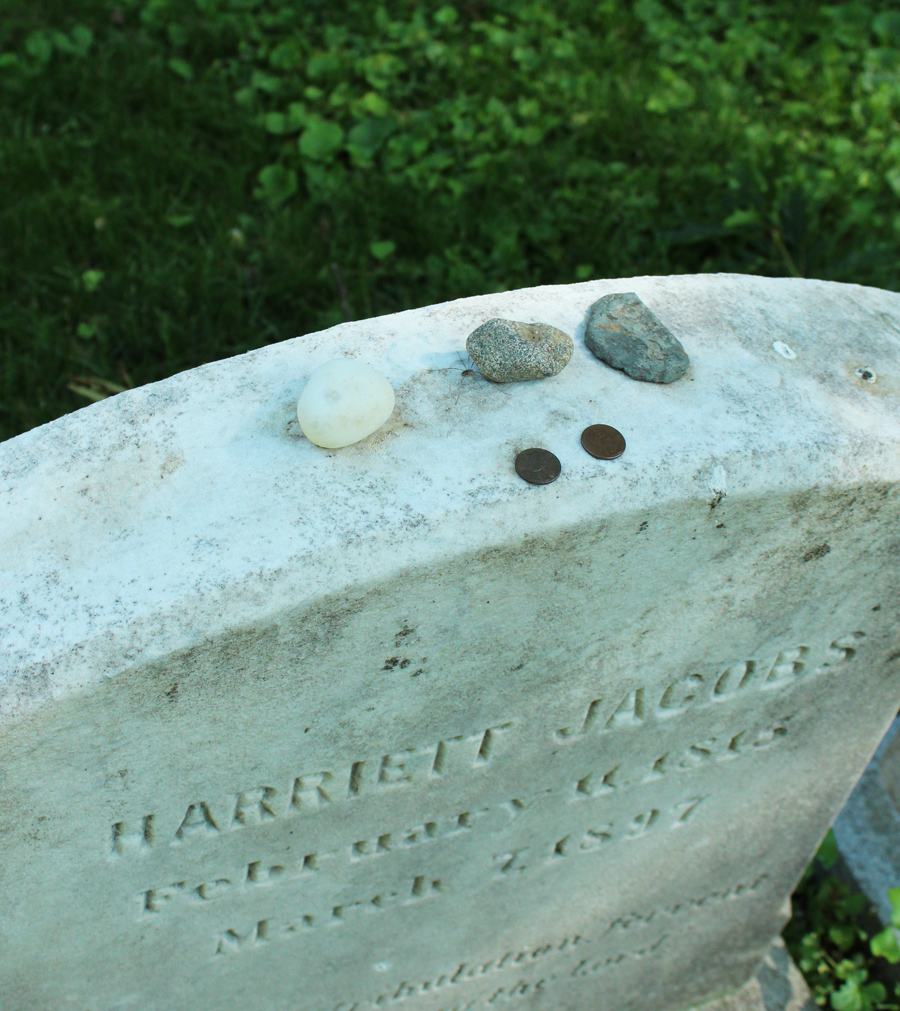
Mt. Auburn Cemetery, Cambridge, Mass.
Harriet Jacobs was born into slavery in North Carolina in 1813. She managed to free her two children, remain hidden in her own town for seven years (while a vicious relative of her owner relentlessly hunted her), escape to the free states, avoid capture after the Fugitive Slave Act was passed in 1850, make a living, start a school after the Civil War, and somewhere in there, to write a remarkable memoir. Incidents in the Life of a Slave Girl tells the chilling and inspiring account of her life. Here is an excerpt:
Pity me, and pardon me, O virtuous reader! You never knew what it is to be a slave; to be entirely unprotected by law or custom; to have the laws reduce you to the condition of chattel, entirely subject to the will of another. You never exhausted your ingenuity in avoiding the snares, and eluding the power of a hated tyrant; you never shuddered at the sound of his footsteps, and trembled within the hearing of his voice.
Ms. Jacobs was initially owned by a woman who promised to free her. As often happened, however, the promise was not made good and Ms. Jacobs passed through her mistress’s estate to the testator’s three-year-old niece. The niece’s father was a lecher and harassed and pursued Harriet until in a desperate bid for safety she allied herself with a white neighbor. That neighbor was Samuel Tredwell Sawyer. He would go on to become a U.S. Congressman. At 16, Ms. Jacobs bore him the first of their two children.

Spring and summer reading
Afraid that her children would be sold or shipped off to a distant relative of her tormentor, Jacobs ran away. The hope was that Sawyer would buy and free their children. Through an agent, he did purchase them. He did not free them.
Jacobs hid in a garage and then the teeny garrison of her grandmother’s home for a total of seven years. She survived horrible cold and heat, invasive stinging bugs, and near loss of the use of her limbs from being cramped for so long. How she managed to survive defies understanding. Like many bondwomen with children, her concern and longing for those children seemed instrumental in keeping her alive.

Harriet’s stone is inscribed: “Patient in tribulation, fervent in spirit serving the Lord”
How she escapes, manages to arrange for the freeing of her children, and her encounters in the north are fascinating and important pieces of American history. This slave narrative is provocative, well-written, and horrifying.
Annette Gordon-Reed’s Pulitzer prize-winning book, The Hemingses of Monticello: An American Family, has been a great companion text to Incidents, particularly on the topic of the kinds of calculations and risks an enslaved woman might make in allying herself with a powerful white man (in that case, Sally Hemings and Thomas Jefferson). It is too easy to say, for instance, that Sally Hemings was a complete victim given the agency, albeit limited, that she exercised.

respects
Just as I was finishing the memoir, I learned that Harriet Jacobs was buried in nearby Cambridge, Mass., in the Mt. Auburn Cemetery. Two weeks ago, K and I went to pay our respects. It was the only stone we saw that day with visible tokens carefully placed on its upper edge. Three stones and a penny. Having forgotten the irises that I meant to bring from my garden, I laid another coin above her name.
* The book spells ‘Harriet’ with one ‘t’. Obviously, her gravestone spells her name with two.


 If you want to know more about Gardner, her extraordinary life, the museum, or the infamous theft of 1990, I’ll leave you and google to it. These are just pictures from a day.
 The new wing houses gift shop, cafe and this lounge. Plus some exhibit spaces we didn’t get to this visit.
 While others checked coats, I found welcome contrast to pewter skies in a narrow greenhouse.
 The early Sargent of a Spanish dancer is one of my favorite paintings by one of my favorite painters. Seeing it and it alone is worth the price of admission (which was gratis for me today but still).





 Gardner was wild for her day. It occurred to me on the way home that if she had been a man, there’d be thirteen biopics about her by now with a new one due out next year.


 BTW, should you hear of a Rembrandt or Vermeer on the black market, there’s a $10MM reward for information leading to the recovery of the five stolen paintings.