Tag Archives: global warming

Getting there

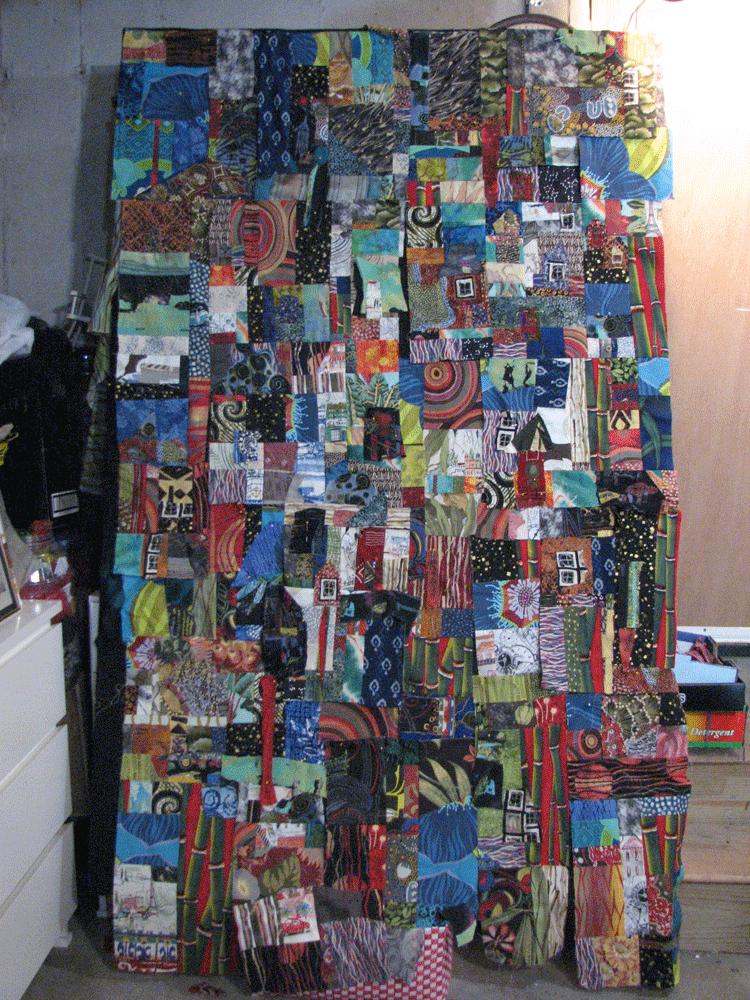
Getting there.  Or not?  I like flickr.  It aids memory.  Refreshes the heart and mind of the cycles that go ’round and ’round.  Some evolving.  Some degenerating.  Reminders of the seasonal.  But, this morning’s search reminded me that a version of this quilt (below), photographed in April of last year, was titled “One Year Into It” – which makes the piece above, “Two Years and A Month Into It”.

So now two things come to mind.

A question – How do I keep my thoughts from turning in on themselves and stewing in a negative pot?  (i.e. “oh god, can’t I finish anything?!!!  will I ever quilt at a satisfactory pace while working full-time?  does that make me wrong to do X or Y?”).

And a NOTE TO SELF – perhaps it is time to employ a trick.  Like the one I used to make a quilt in honor of the women of Gee’s Bend.  THAT trick was – quilt must be made ONLY with scraps on floor or worktable and had to be designed in a single session.

For this, what?  A deadline?  No – it has to have something more than that.  Any ideas?

Work from the bottom up?  Letting the blue seep up and in (the rising waters associated with global warming)  Let the blue be the filler when two irregular patches are coming together?  Let the OFF-ness of the blue – its unintentionality, its potentially non-pleasing placement – stand for the idea that the consequences of global warming are unpleasing, don’t fit, and create mismatches of a truly awful nature.

Not to get too serious about it all, of course – because being too serious is a great way to stay stuck.

truing up and screwing up

I have always liked the phrase, “truing up”.  It implies getting things straight.  Coming into alignment.  Making the edges workable.  And because I mostly eyeball the lines in the early stages of my quilts, truing up also indicates progress toward finishing.

And then there’s screwing up.  As in orienting one large section of the bottom of the quilt up-side-down.  Oh well.  Good thing I am developing a new relationship with my seam ripper.

intended, upper right

upper right, upsidedown

Heirloom Poppies

heirloom doily for a pillow

This week’s pillow commission required extreme care.  It required symmetry and therefore measuring.  It required keeping fabric that wanted to crinkle, flat.  It required being able to FIND the doily.  My iron had to be pristine at all times.

Hole before -- muslin scrap slipped under, no glue

There was one minor flaw in the doily — the round hole shown above.  It wasn’t that noticeable until one placed the doily on the coral-colored silk, and then it was VERY noticeable.  I didn’t want to use a glue-product like WonderUnder to adhere a teeny piece of muslin under the hole, so I stitched it carefully — without turning under the edges because that would have required enlarging the hole.

Hole after -- edges left raw to minimize size of tear

Long ago, I learned that white-glove production is not for me.  Professional curtain-making was a casualty of this recognition.  I tried it briefly.  Loved the design challenges, fabric selections, and money, but couldn’t stand the sweat and worry.  And if you don’t know what I’m talking about, then you haven’t seen what schmutz on an iron can do to a fully-assembled white linen Roman shade — in about four seconds.

Exquisite embroidery -- tough to iron flat near its contours

I am hoping that my small quilting stitches don’t detract too much from the beautiful embroidery of the poppy.

Light quilting to anchor doily to silk

The process of working on this pillow has heightened my appreciation for working congruently… working in a style, palette, and scale that is in accord with one’s basic wiring and temperament.

For instance, do you plan or jump in and clean up your messes afterwards?  Are you a designer who makes sketches or who doesn’t?  And if you do, are those sketches made prior to taking a stitch and/or during construction?  Do crooked lines bother you?  Do straight lines?

What do you do if you are an improv quilter and suddenly must meet specific demands imposed by a commission? (this week’s rub, for me).  And, given your basic disposition, how do you tolerate being on a learning curve?

Coral-colored silk a winner with the poppies

There are fiber artists out there, by the way, doing unbelievably beautiful things with antique linens.  For an exquisite use of heirloom cloth, please visit Kaye Turner’s blog.

Yesterday, when I finally got back to ‘doing what I love’, I found myself stymied again, because this huge Global Warming quilt will not let itself be resolved.

Iteration 735! Horizon re-emerging

Pitbullish about its size, I am resisting the temptation to break it into smaller pieces.  I could easily create four smaller quilts.  It keeps morphing this way and that and I truly can’t tell if it’s getting closer to resolution or not.  Last night I lay in bed counting on my fingers how many BED SIZED simple geometric quilts I could have made with the time I’ve spent on this.

What I have decided therefore, is, to piece it up in its unresolved state and then to ‘paint’ with applique to bring the thing into harmony.

blue edge near top needs broken up

brown edge near middle needs disturbed

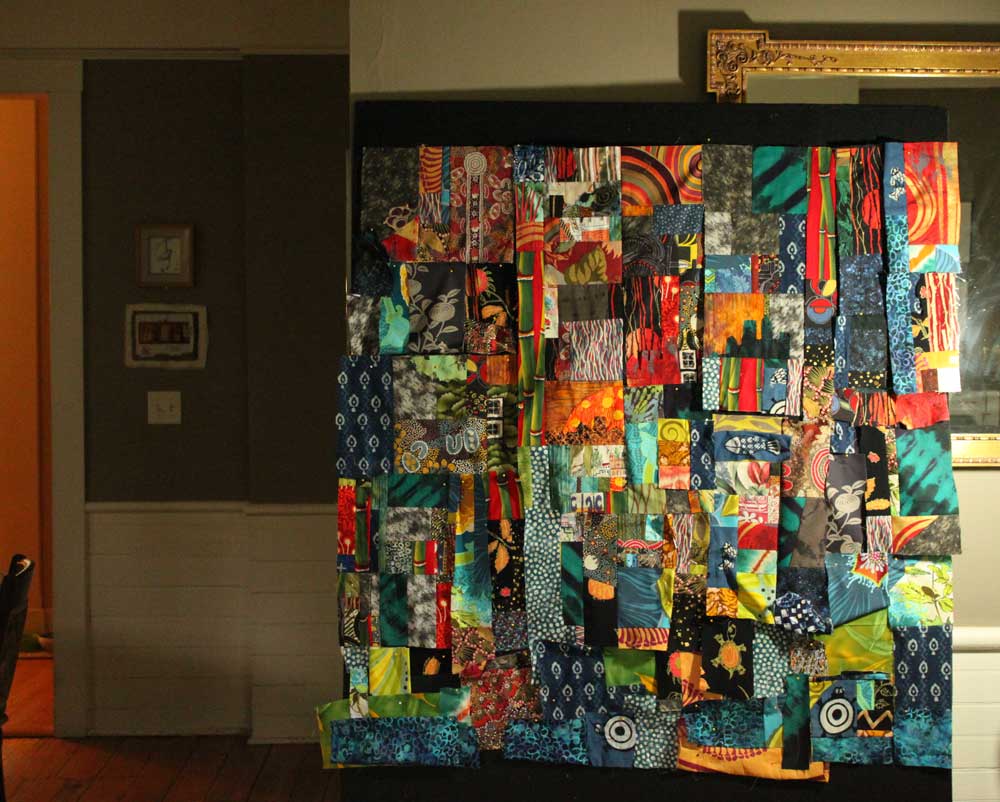
another Global Warming "spawn" quilt

spring light

The spring light flooded our family room late this afternoon.  I don’t remember it ever being lit up like this before.  By the time I got my camera out, it was the shadows that interested me, so I haven’t captured the golden warm moment at all, really.  I share the photo of our kitchen TV and dinner clutter only because it DOES capture the light a bit better.

When I look at this picture and I don’t think, “Gee, cool, there I am in the reflection.”  No, I think, “Why was that light on?!”

Soon, our neighbor’s 200 year old copper beech will leaf out, and the light will be dappled and less intense (and that’s nice too).

With the poppy pillow commission finished, I can finally get back to my big-big quilt.

Recycled shirts and tiny pieces of Most Favored Fabrics (like a trading status!) are turning into huts and villages, here and there.


I took so much time to piece these big sections, that it would be a shame if I hid all the evidence of that work (i.e., the SEAMS), but that is the temptation right now…

That blue spade fabric (a roof of rain?) is cotton that K. brought back from India last month.  It was hard to cut, because it was such soft cotton, but cut I did. It is one of many fabrics that translates into “RAIN” in this piece.

Lining up

lower right section of Global Warming 7-footer

I keep going back and forth on this project.  Should I complete it as intended (roughly 7′ x 4′), or break it into sections and move the thing along?

This little section (photo above) floated upstairs today and looks complete to me.

But I’m not quite willing to give up the big design yet.


Because I am not a planner, at this stage of production I often find ‘log jams’, or areas where the rectangular pieced sections are not lining up and where I am not willing to chop or add to accommodate completing a rectangle.


Once I pinned up some green grosgrain to divide sections, it suddenly seemed (seamed?) do-able.  Note to self: remember that this is a visual process and that you have a visual sensibility (“DOH”).

There have been quilts that undergo enormous changes at this phase… quilts where I find myself swapping out some of the larger chunks.  This has been partially in service of making the rectangles fit (think “Tetris”) and partially  because it can be fun to see how things look when the design is a little less conscious.

This particular piece, however, has been in formation for well over a year and I am eager to get to the final stretch.  And, I am feeling a strange loyalty to the design as I have constructed it.

The edges will pose problems.  My plan is to use some of the cool-toned patterns (the Anna Maria Horner large blue floral and a shimmery green near-solid) to fill in and frame the edges where I need another inch or two.  I will TRY to avoid the temptation to keep piecing/adding complexity.

What will be fun is to create a slide show of the quilt in its many phases and see how it has changed over four seasons.

For the finish — instead of using a whole cloth back and pinning the entire thing up and shoving it through my Bernina with a great deal of cussing, I think I’ll quilt it in sections.  I plan to use some overlays on the back, perhaps even with raw edges, to connect up.

Given that one of the problems with this piece is its scale — I really don’t love working this large — then it is obvious that if I want to continue producing pieces of this size, I have to figure out how to do it in a way that works with my style, studio space, equipment, and temperament.

Which reminds me that my word for 2010 is ‘congruence’.

I am so, so eager to find both the style of working and the subjects & images that really line up with who it is that stands with the needle in her hand, with the scissors at her side, and with her particular demons at her back.