Tag Archives: applique

“Steal Like An Artist”

beginning

select subject and materials

The book “Steal Like an Artist” is a great and inspiring volume. You can read it in an hour and a half, and should, many times.

Here are a few of artist/author Austin Kleon’s liberating and clarifying concepts:

  1. “Nobody is born with a style or a voice… We learn by copying.”
  2. Copy your heroes.
  3. Copy from more than one source.
  4. “You don’t want to look like your heroes, you want to see like your heroes.”

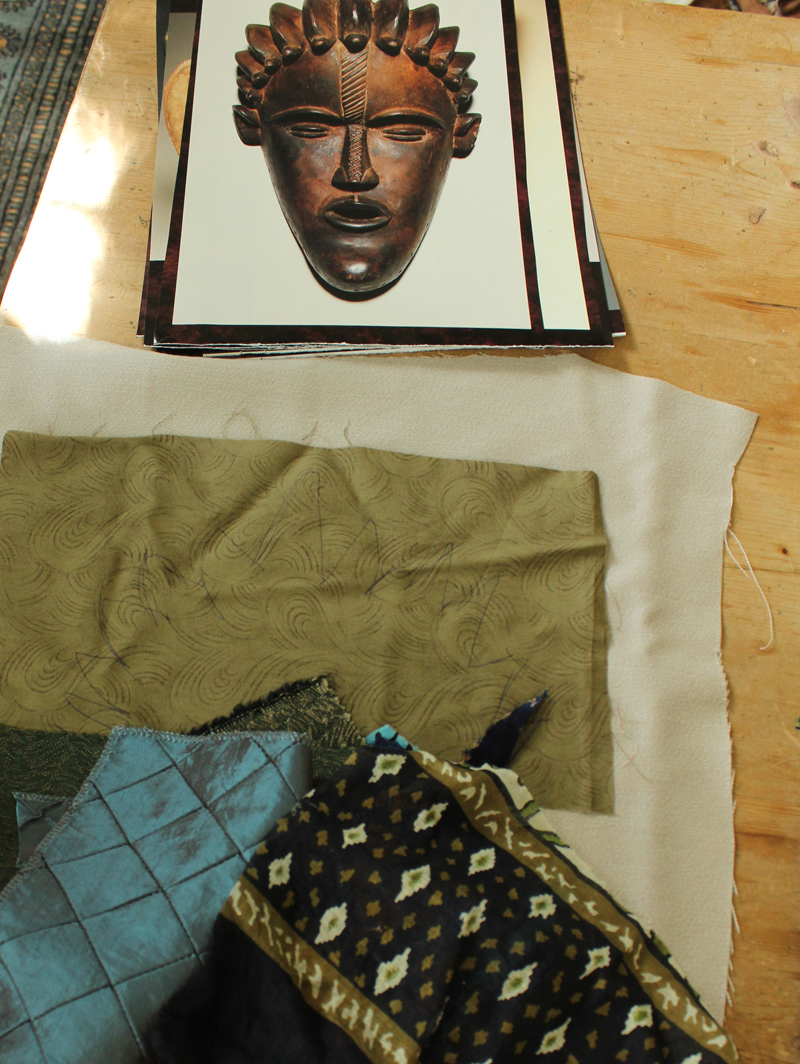
In that vein, today I celebrate a cloth face put together in preparation for an upcoming children’s quilting workshop that I’ll be teaching at the Boston Center for the Arts.*  This exercise served two purposes. One, it acquainted me with the project on the tactile level – obviously important when teaching. Two, it gave me a chance to express something, so there is less chance I will insert myself into my students’ work – always a peril for teachers, particularly of young people.
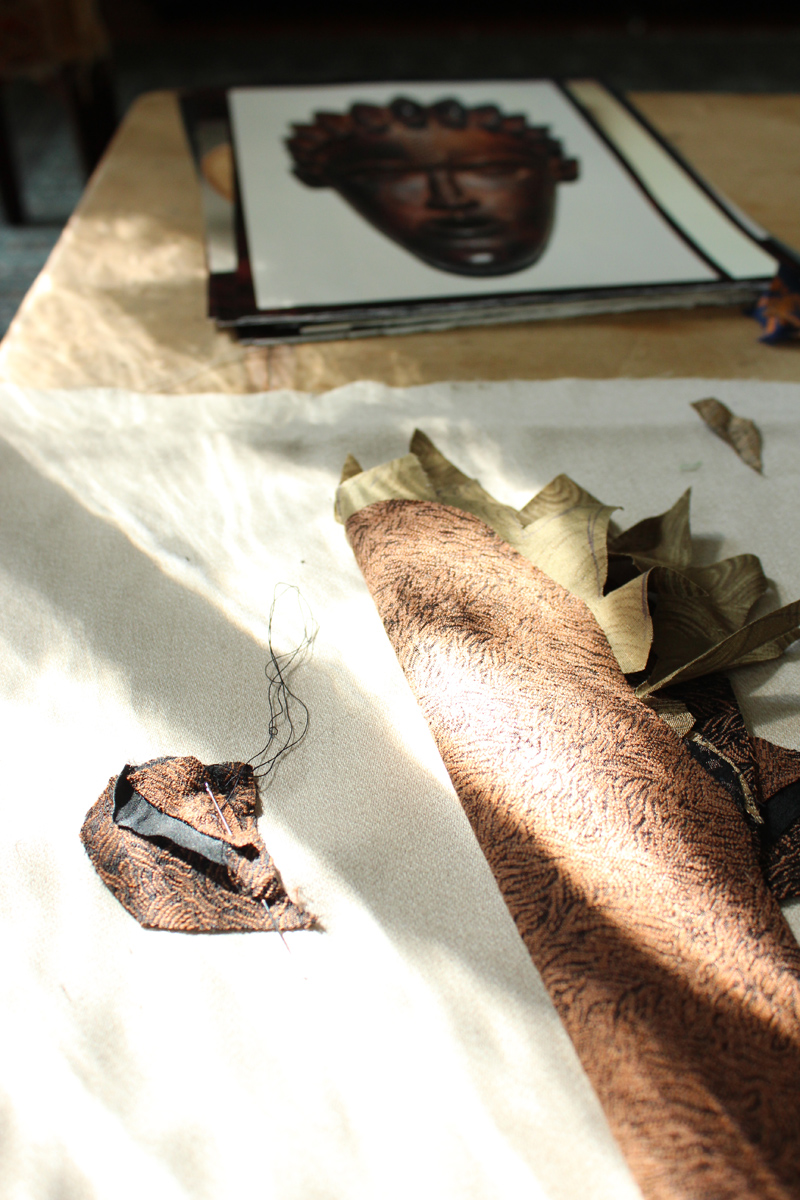
tacking-ear

tacking ear down

So, from whom do I steal here? At least three artists.

One, Jude Hill. Jude is a master quilter whose techniques and philosophy I have been studying (and copying) for quite some time now. Her teaching style is completely geared to Number 4, above — in other words, she isn’t trying to show her students how to make work like hers. Rather, she is openly and consciously trying to get her students to SEE like she does. Philosophy and process instead of recipes. (her blog: Spirit Cloth on sidebar)

How is her influence present? This time, primarily in technique and a quality of attention:

  1. The attention to the materials themselves (selecting fabrics with a nice hand, easily penetrable by a needle).
  2. The use of invisible basting to adhere the layers.
  3. Managing the layers by carefully inserting batting under face only.
  4. Hand sewing some components together prior to basting the entire piece – eliminating need for numerous pins or glue.
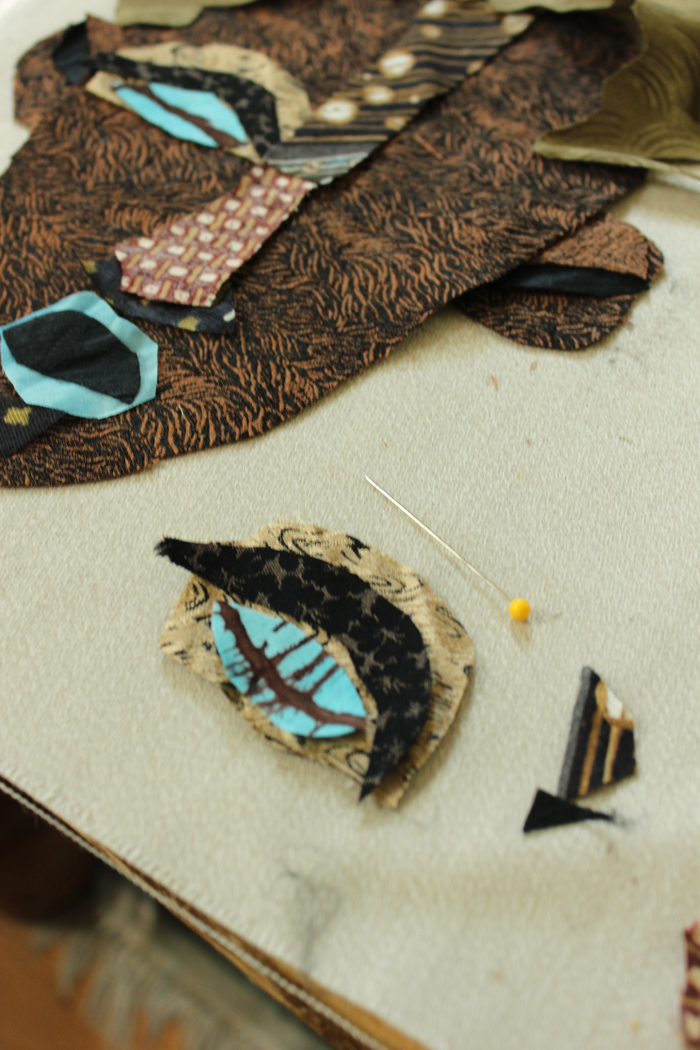
assembling eye BEFORE all-over basting

assembling eye BEFORE all-over basting

Who else?  Susan Carlson – the wonderfully talented pictorial quilter from Maine, whose collage-style technique I learned in 2001.  Her influence:

  1. An illustration approach to rendering the subject.
  2. Building layers from the bottom up.
  3. A liberal combination of patterns.
couching a single strand of satin cord

couching a single strand of satin cord

The third and perhaps most important artist:  the sculptor of the mask. Unknown. Gbi artist, Liberia, early twentieth century.
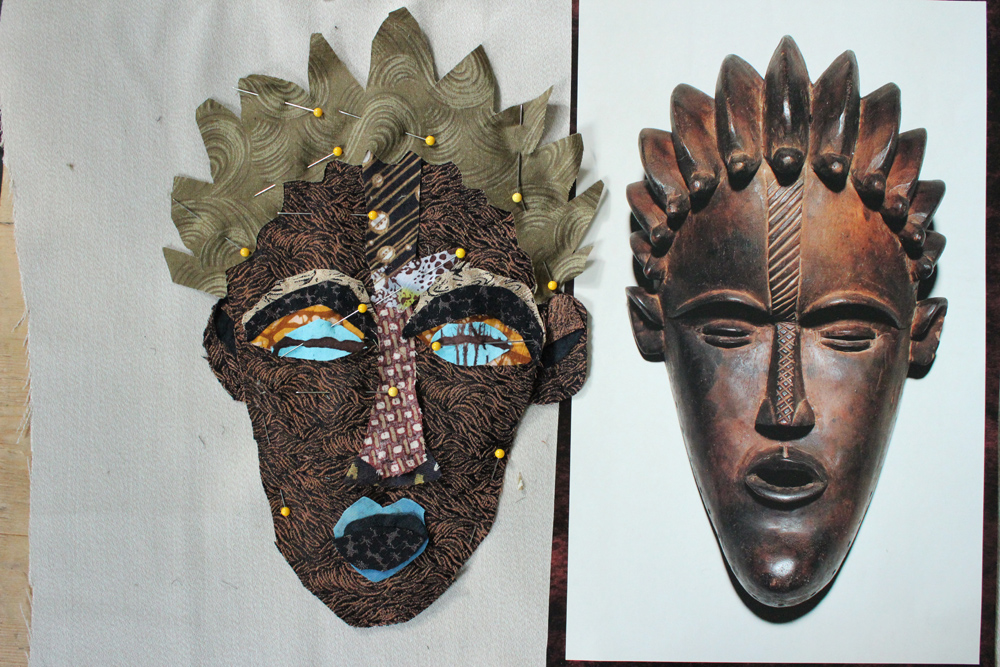
side by side - eyes not finished

side by side – eyes not finished

I would like to try this again, because I missed on the proportions – that lovely length to the face and the broad, regal forehead got a little squashed in my version. I needle-sculpted the cheeks a little, but next time I would want to use color to add light around the nose and on one-half of the forehead.

Apropos of ‘missing’ (I don’t really like the final product all that much, in fact) – I’d like to add how critical being able to screw up and try again is for creative endeavor. My most favorite spokesman on this is Ken Robinson, the English education specialist. Clearly other people find him worth listening to as well — the last time I posted this link, it had been viewed 7MM times. It is up to 16MM views now!

round-one

All layers together, with some embellishment

*  I will be teaching “Patchwork Faces” – a workshop for children, on May 18, 2013 from 10:30 to 12:00. You can register here:

http://bcaonline.org/public-programs/families-connect.html

Then, on June 1, from 10:30 until 1:00, I will teach a class for adults called, “Sew What? Improv Quilting”

http://www.bcaonline.org/visualarts/mills-gallery/now-showing.html

Both class are offered through the Boston Center for the Arts
539 Tremont Street, Boston, MA
617-426-5000

Simple pleasure / simple need

coffee steaming by dee at clothcompany

Today I offer a quote by Wendell Berry from his 1987 book, “Home Economics” —

“Once we grant the possibility of a proper human scale, we see that we have made a radical change of assumptions and values. We realize that we are less interested in technological ‘breakthroughs’ than in technological elegance. Of a new tool or method we will no longer ask: Is it fast? Is it powerful? … We will ask instead: Can we (and our children) afford it? Is it fitting to our real needs? Is it becoming to us?”

Even though in this post-internet age, speed and innovation seem to matter to us more than ever, these strike me as worthwhile questions.

coffee pot cloth backlit

And yes, I am still working with white, though this morning I pressed a mound of brilliant green and indigo blue squares. I nearly swooned after so much tan, beige, linen, oyster and ecru.

progress in white

Slowly getting the hang of our updates. There definitely are improvements in the offing.  For now, I am just moments shy of a good, long walk in the spring air, then it will be time to walk to the periodontist for the insertion of an implant (yes, sympathy is welcome!)

In other words, this post will be quick. A report in pictures. WH = “White House”, the very original name for this piece.

WH - scraps laid out

WH – scraps laid out

WH-full-orig

WH – seamed, with some embroidery

WH-right-corner-orig

WH – pre-whitening close up

WH-rt-stitched

WH – same area, both whitened and layered (the silk had color and pattern)

WH-upLT-pinned

WH – sheers pinned over whitening white running stitch (grey splotchy roof does not stay)

WH-upRT-pinned

WH – sheers pinned on the other side of the roof

WH-top-stitched

WH – more whitening with the addition of white running stitches (grey roof is gone)

sheering-sky-4

WH – celebrating the shredding orange silk by tacking it down; one sheer had embroidered loops on it, seen here

v-fading

WH – getting there

WH - hanging

WH – hanging

the FREEDOM to tell a story

Each Thursday, I sit with a group of women and spill out writing under the tutelage of a teacher trained in the Amherst Writing Method as developed by Pat Schneider.

One of the key elements of this method is that all comments must refer to the ‘narrator’.  Even if a participant writes in the first person — the rule holds.  Is this a reliable narrator? A sympathetic character? Is she holding back, or giving us lots of details?  If a participant strays, and refers to ‘you’ or directs queries suggestive of the assumption that the writer is the narrator, our fearless leader corrects course.  “You mean the narrator…”

Why so important, you might ask?

Freedom, pure and simple.  Afterall, our writing session is not therapy and it is not a support group.  Not that we are impersonal with one another — not at all.  But it is nevertheless the case that even with pledged confidentiality, the protection of writing as a narrator is essential for creative flow.  It is actually a profound freedom.

In that spirit, I am working on letting cloth tell a dark story.

Here, where there IS no confidentiality, I am trusting my readers to hold the story of the cloth as if we were all trained in the Amherst Method.  In other words, I hope you ask yourself, “is this quilt successfully depicting trauma?” rather than, “good lord, what happened to you?!!”

At the ripe age of 55, I have come to believe that although we are each born with certain gifts and certain curses, and that they shape our thoughts and feelings in profound ways, on some level the details REALLY DON’T MATTER.

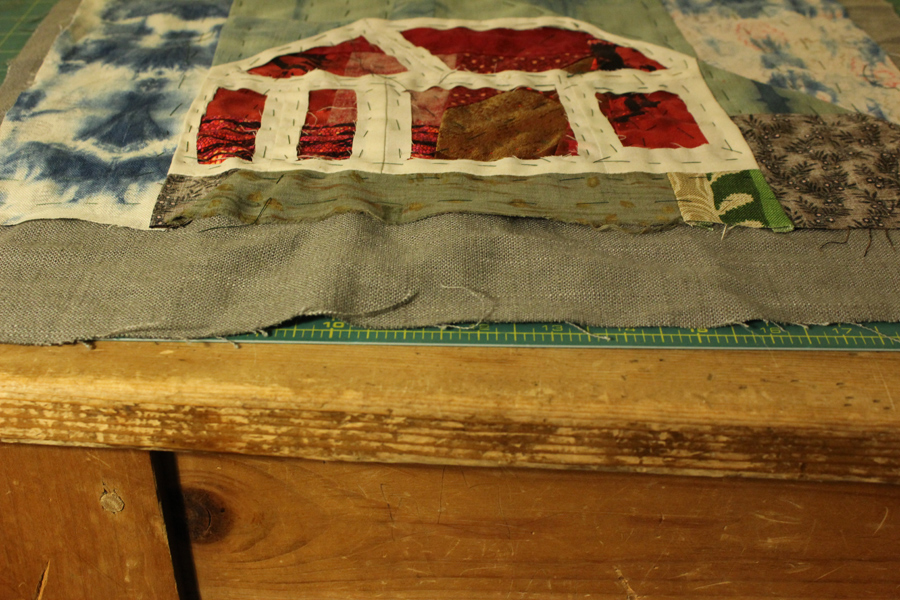
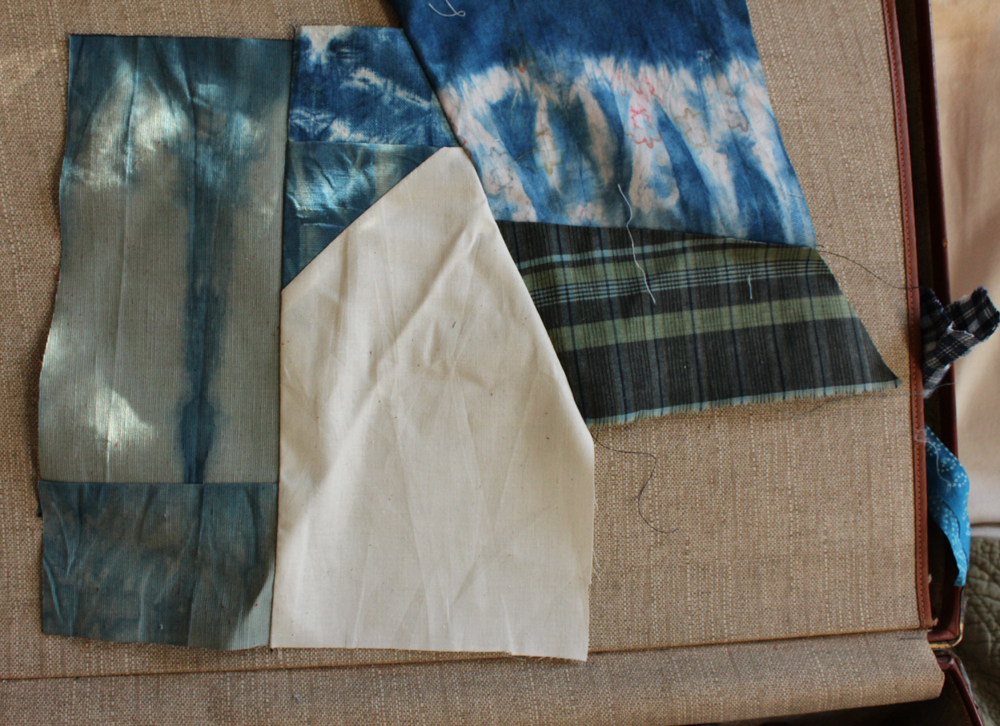
And so, I begin a house quilt where the symbol is not Security, Safety, and Solace, but rather a place of upset and fear.  I started with a simple muslin construct.  I pieced it to a ground and sky, because I wanted it to retain some sense of place once I started cutting it up.  I free-pieced some red fabrics that would be revealed when I cut open ‘windows’ and ‘doors’ in the house structure.This all happened in the span of an afternoon.  A very sunny day before Thanksgiving.
It was hard to stay the course on cutting, and in retrospect, I wish I had left the rest of the roof intact.
Even though I wanted the idea to include that the outer and the inner are severely mismatched, I like the way the red trunk points downward to the linen/green branch of the foreground.
I used a dark green thread to baste the house, the red under sections, and a swath of grey linen together, and the minute I started doing more detailed stitching, I regretted that.  The threads get in the way and I am spending a lot of time cutting and removing them.  Not sure, now, why I opted NOT to use Jude Hill‘s invisible basting method.
I had gotten a little lost for awhile with THIS detour (above)… and forced myself to return back to basics, then making the muslin house of the other photos.  Funny thing, though, when I laid the above-scrap over the basted quilt-in-progress, I found I liked it a lot more.
Not sure what I will do about that – if anything.  I plan to keep stitching the existing layers together, and then I’ll see.  The other little surprise, which goes to content here, is the appearance of an Indigo Angel.  I had absolutely no plan to address healing or grace or serendipity with the piece, and yet, as is so often the case, the quilt had other ideas.
There she is, clear as clear can be (she even has feet, which you can’t see in this picture) – fluttering her wings next to a heart-shaped face!

dunking, dingy, houses and blues


This is the vertical Middle Passage quilt, after adding some cloth and rubber band resists to lower edge and dunking into indigo vat.
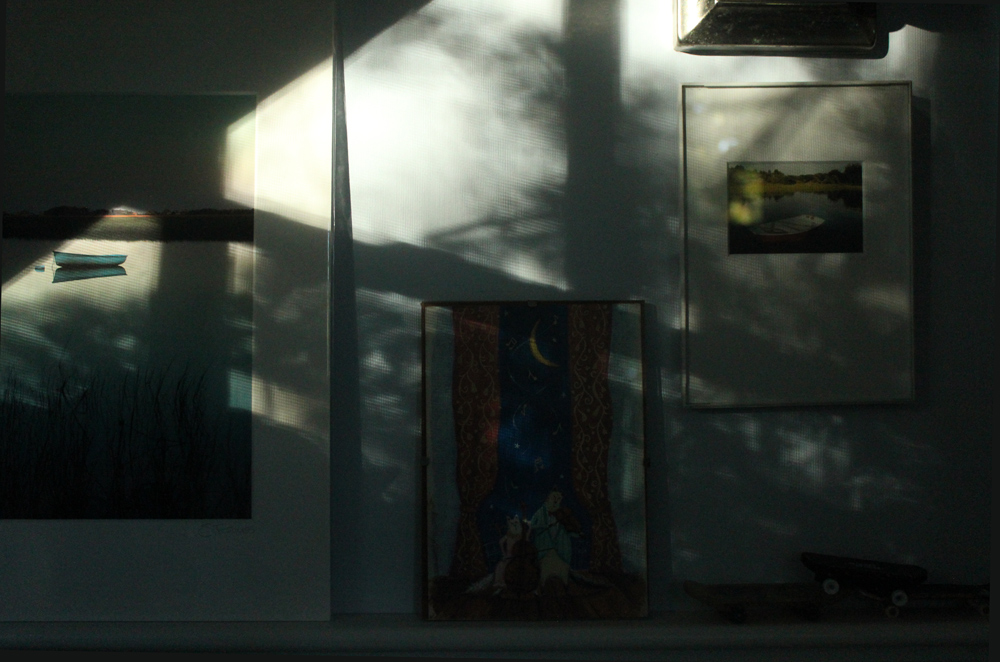
Our bathroom receives late afternoon sun – from the weekend.
It was such a beautiful day here.  Since we abut an elementary school, all my activity out back this morning was accompanied by the sounds of children playing.
I was happy to spend some of such a glorious day outside with cloth, and raking, and taking a walk around Crystal Lake.