Tag Archives: “dee mallon”

perspective – not necessary, but good!

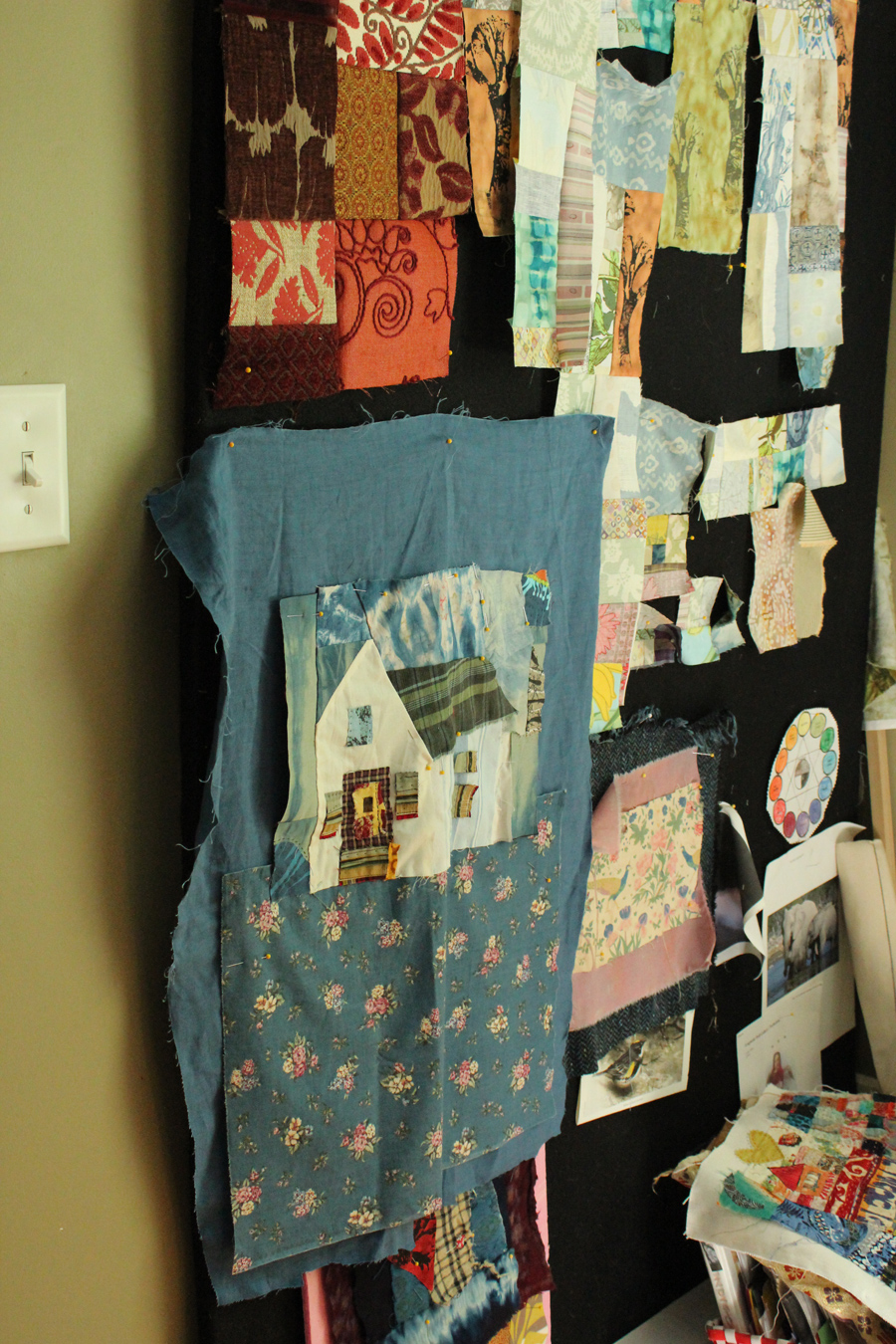
house-before-roof-and-side-fix

straight base translates as flat; roof line doesn’t match up with house

This white house emerged months ago as I pieced up muslin for what would become the “Red House”. I was immersed in barn raising at the time.

sideways

pin board

house-and-chair

roofline better; perspective created with a single strip of blue floral slanting up from front corner to back corner

Two different green plaids are used in the roof. I think another piece is required to overhang that right rear facade.

real rooflines

real rooflines – earlier in season, many years ago

There are flash flood warnings here.  My phone actually honked to tell me so. Based on the rain and wind, I would not have guessed there to be any danger (and maybe there isn’t).

Speaking of phones, when I took my failing-to-connect-to-the-internet iPhone to the Genius Bar, everything operated just perfectly. The ‘genius’ took notes (on his tablet, naturally), but I could tell he thought I was a technology-challenged moron (and maybe I am). However, I came home and all the same problems reasserted themselves. And I don’t see how it could be an issue with our router, because everyone else in this household is connecting to the internet just fine.

As maddening as these tech issues have been — for weeks now (Photoshop crashed twice while posting yesterday — one time recovering; one time not) —  I really could use some perspective there as well.

What is the emotional equivalent of a blue strip of fabric lightly laid, just so, to make the line of the foundation travel back? What perspective would ease getting through a series of technology issues that show no sign of easy resolution and that undercut my ability to stay connected (and THERE’s the psychological metaphor for one of the mechanical failures — it’s always there).

“WALK AWAY FROM THE SCREEN, Dee” isn’t going to cut it for much longer. I should take Michelle’s comment from yesterday to heart: “Breathe”.

when to abandon, finish, or begin again

How do you know when to abandon a piece? Or, if the decision is to spare an unliked work, how do you go about finding the will to finish it?

scene-precut

borrrrrrrrrrr-ing!

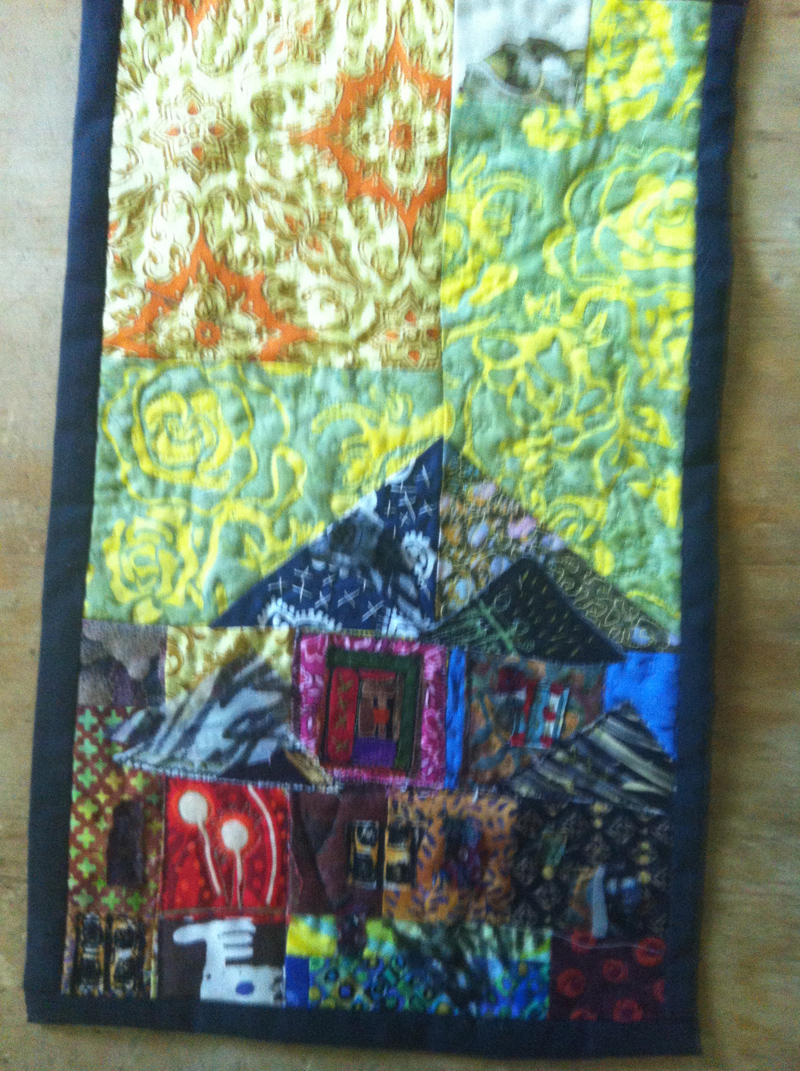
Shooting this little quilt out of focus and cock-eyed accurately captures my lack of affection for it. Initially, I set out to ‘improve’ it by continuing to applique scraps — applying some sheers for additional interest and a variety of teeny chips of geometric prints to suggest more windows. However, the backing fabric is a polished cotton (and I suspect designed for outdoor use) and it became evil to try and stitch through.

So! I cut it up.

rearranged

more interesting already

Cutting up a quilt otherwise designated for the garbage doesn’t take much nerve, particularly when you haven’t spent all that much time on it the first place. Now I am committed to finishing it and will use one of the Berninas to do so (sparing the thumbs is generally a good practice!)

So — NOTE TO SELF — prior to abandoning a piece, you can:

One – cut it up, rearrange it (if necessary or fun, cut up TWO quilts and mix and match). (DONE)

Two – Using a zig-zag stitch, butt edges together and unite them. (DONE)

Three — Add additional scraps to surface, in my case more rooves, windows, and a red hot sun.  (IN PROGRESS).

Four – bind or not. I’m a lot less compulsive about the need for a traditional binding.

Who knows? Maybe this little Summer Village will usher in a whole slew of Finished Things.

For the first time EVER I am viewing the prospect of a period in which I limit myself to the task of finishing in-progress pieces as something appealing — as a source of freedom, even.

Funny isn’t it? How something that for years (finishing, finishing and focusing on finishing) has seemed nothing but an exercise in the SuperEgo — dull, lacking in spark, with an oppressive need for semi-accuracy — can suddenly carry a whiff of delight?

Perhaps this is a testament to the weight of things undone.

And perhaps this new stance on finishing is an indicator of just how toxic the process of selling your work can be. In most of the previous ten years, finishing a piece was synonymous with readying it for sale. That’s a big “UGH” all on its own, and it must have carried a large enough spread of contamination to pollute the process of finishing.

marcias quilt

actually, many quilts were completed to give away as gifts!

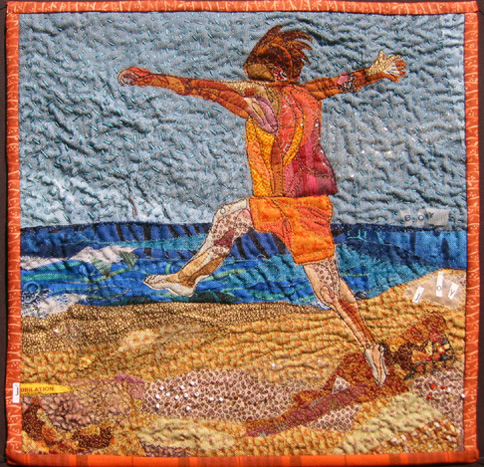
BOY_JOY_72

Just wondering. Didn’t mean to sound SO incredibly down on selling.

holly fair booth

Holly Fair, Cambridge, Mass. — one of the very first craft fairs I did

Can you imagine a whole wall of Global Warming quilts (mostly pieced already) backed and quilted and edges finished in some manner?! The Witness quilts (two of them, I think) — bound and complete? The Middle Passage quilts resolved (remember? I dunked two of them into the indigo vat, which kind of stopped me short) — bound and quilted as well?!! A couple of baby blankets, quilted and bound, if only to donate them to Children’s Hospital (because there are some – uh-oh – bumps that I won’t be able to quilt out).

adding tornadoes and rain to Global Warming WIP

adding tornadoes and rain to Global Warming WIP

First step I suppose would be to make a list.  Isn’t that often the First Step? I’m willing to wager that I have more than 25 quilts in progress.

We shall see. We shall see.

On another note — Hope everyone had a Happy Father’s Day!!

We did. First, with a visit to my sister in Salem (we ate hot dogs next to her alley-sidewalk garden) and then with a meal at our kitchen table together (a rarity these days). K. wasn’t even supposed to back from China yet, but his meetings wrapped up early. So being altogether was treat enough, but then C. brought dinner from the supermarket where he works and I made Fallen Chocolate Cakes (only 3 Tbs of flour!) which we ate with vanilla ice cream, and in my case, a fair amount of moaning. D. gave his father one of his best B&W prints of the mountains that he photographed (on film!) during our recent trip to Arizona.

print and pinhead

print and pinhead

teach what you want to learn

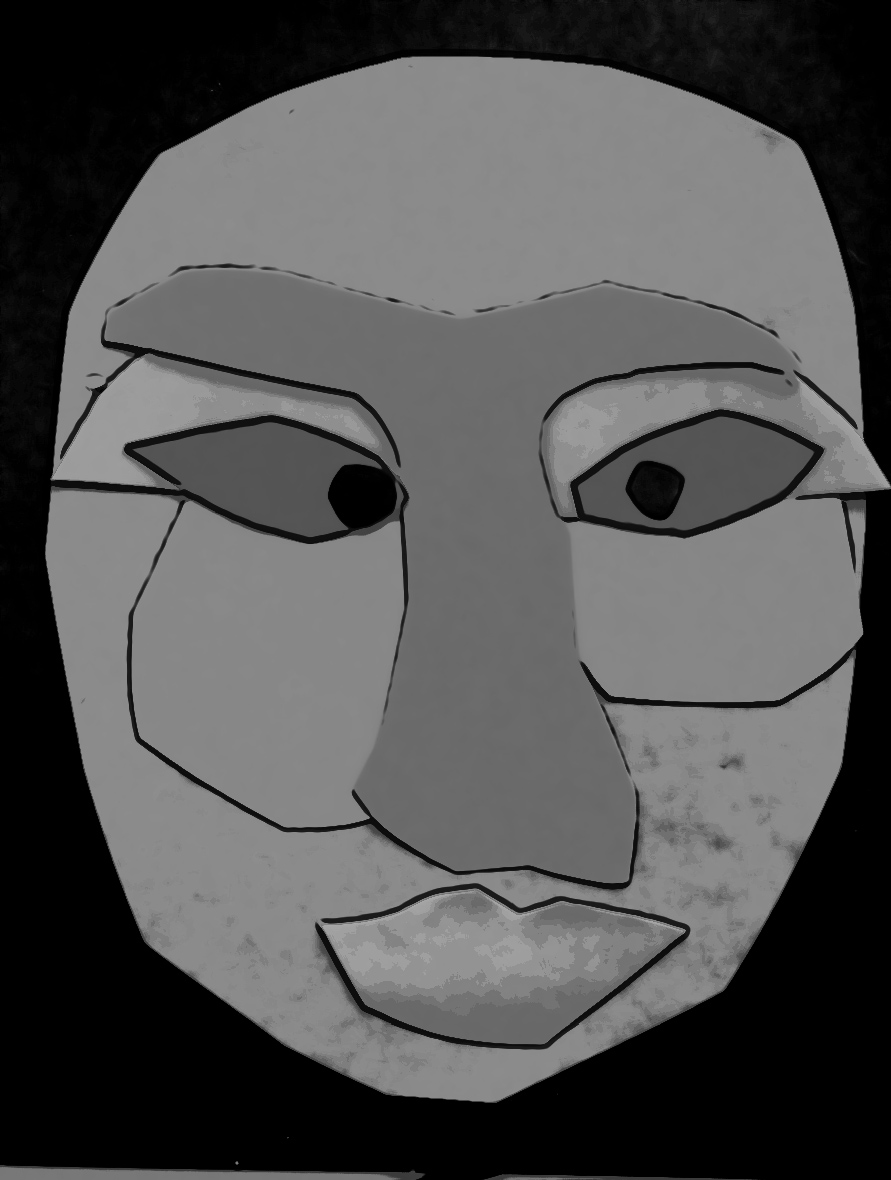
face-shapes-traced

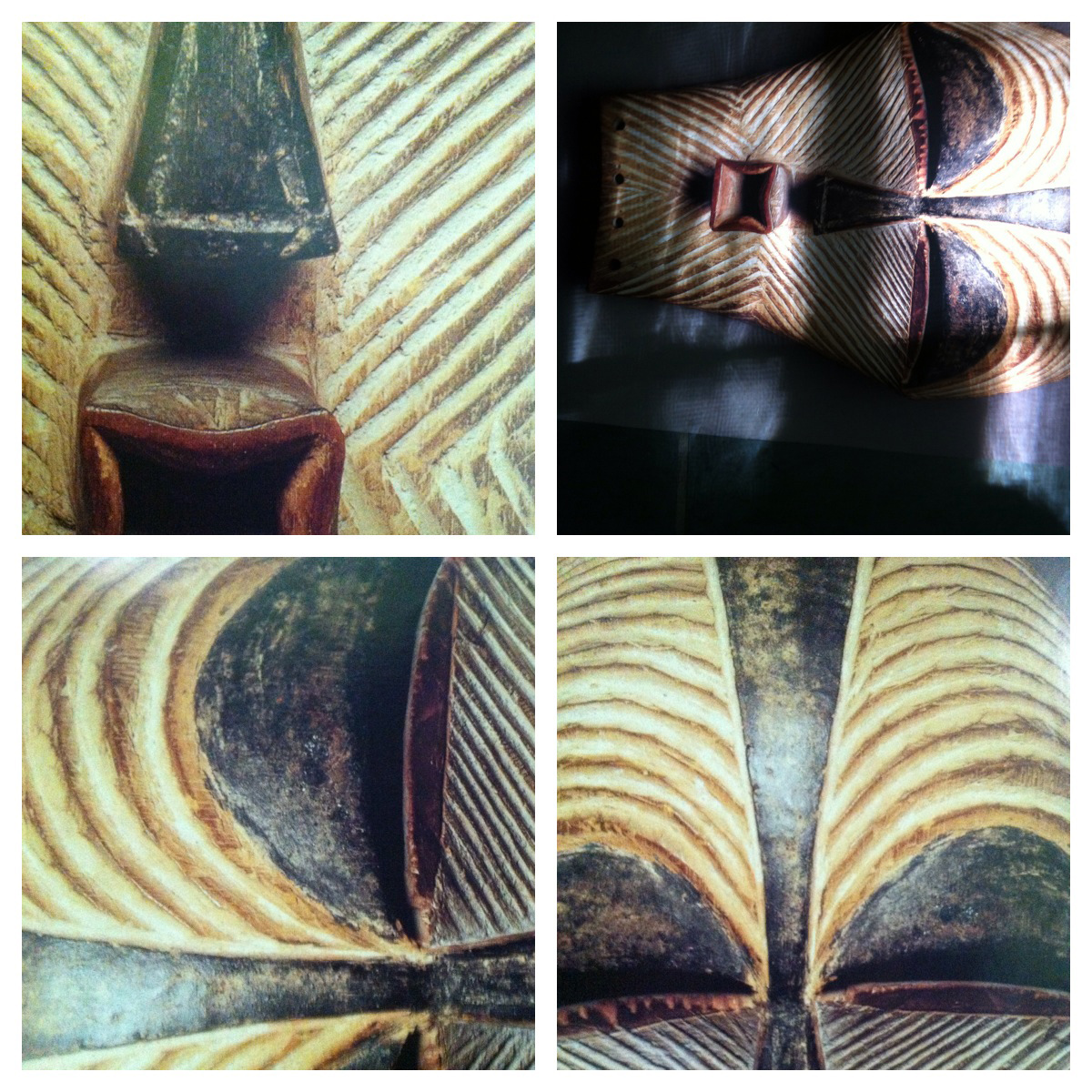
simplest components from African mask (see last picture, below)

We’ve all heard that right?  We teach what we most want to learn.

On the eve of teaching another class at The Boston Center for the Arts, I ought to be asking, then, “What is it that I want to learn right now?”

Hmmmmm. How to take a motif, maybe, and ‘go deeper’ with it (whatever that means). But I know what that means.

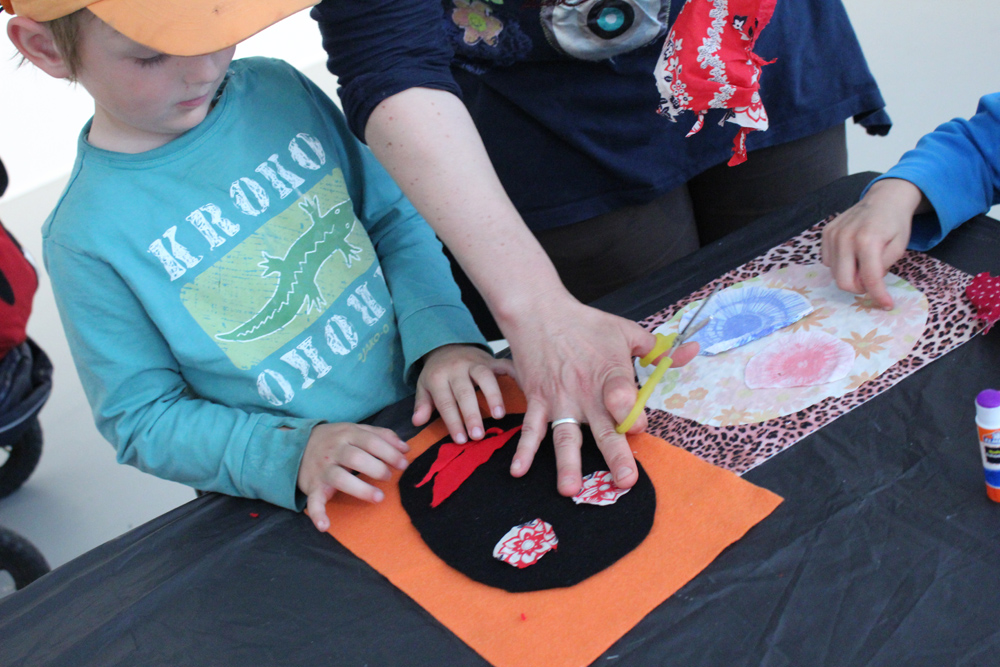
teaching

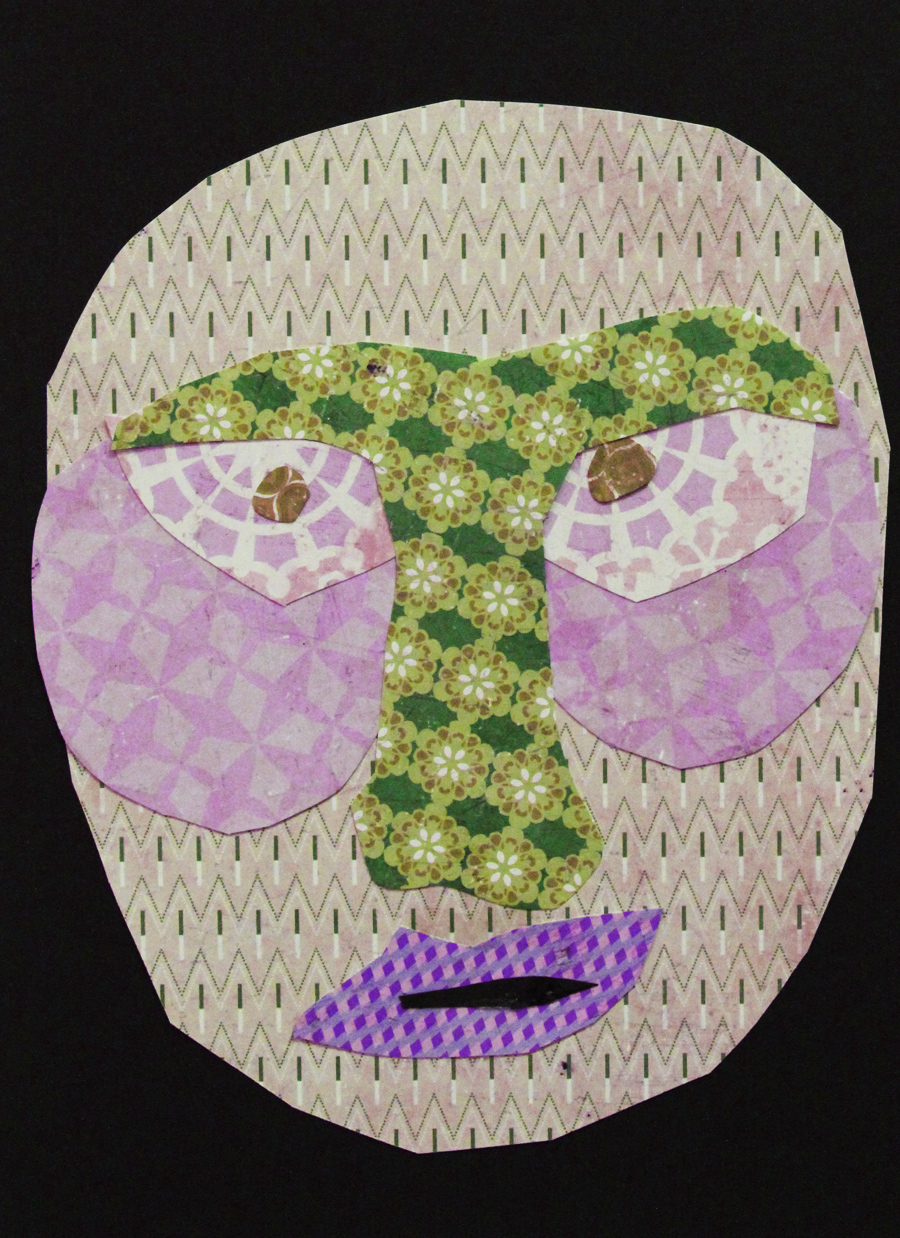
making faces

Or here’s a corollary: we give the advice we need to follow. This is extremely useful for me personally, because two of the people I routinely give advice to are Oppositional, with a capital “O”. Sometimes all I can do, is turn it around.

What advice have you given recently? Don’t fudge it by scanning memory for advice you WANT to hear. I recommend just thinking of the last three things, the most recent things, you have said to someone… in an effort to be helpful.

I’m always telling certain people to be more organized, or more responsible (and yes, yes, that applies here) but here’s the most recent thing offered:  yesterday, I suggested to someone that she partner written memoir passages that are painful with those that are joyful, so that the juxtaposition told a story, on top of those told in the passages and, possibly, to make it bearable to write the really tough stuff.  My idea for her was that a one-two step like that had the potential to turn into a dance, given sufficient air and trust.  So? Trust. Give work air? Partner the ‘uck’ with the ‘yahoo’? That’s probably pretty good advice for me right now.

four-faces-blue

building from the bottom up

Little changes make big differences

Little changes make big differences

eye lid adjustment

eye lid adjustment

looking askance

looking askance

add patterns!

add patterns!

Tomorrow’s adult class will be ‘more sophisticated’.

two sections (top and bottom) that may or may not belong together

two sections (top and bottom) that may or may not belong together

But, I’m wondering, maybe the more you break a thing down, the more complex it becomes. This I have seen time and time again in the manner of Jude Hill‘s designs and thoughts and cloths… the simpler she makes it, the more avenues spin off in every direction.

So maybe for the adults, I should make it EVEN SIMPLER!

Female kifwebe mask, late 19th or early 20th century. Unknown Songye artist. Democratic Republic of the Congo

Female kifwebe mask, late 19th or early 20th century. Unknown Songye artist. Democratic Republic of the Congo

Something lightens

river-house-placed

“River House”

This house was built in preparation for the class I’m teaching this Saturday at the Boston Center for the Arts.*  While probably not apparent to a viewer, this quilt pulls together many elements of recent learning.

How so? For one, it’s lighter than I usually work (exploring white online with Jude Hill).  It has a less defined horizon line. The house sinks into its surroundings better and displays a little perspective (the two barn pieces taught much!!! here and here).  And, the attachment techniques are more refined (and yes, that is the same green plaid I used to roof the two big Barns).

river-house-only

component building

Off-top building” —

By that I mean connecting small elements with stitch prior to trying to connect them with the background (the “top”).  In this case, I HAD to stitch these teeny house elements together, because I couldn’t keep lifting and shifting the background fabrics without going nuts if I hadn’t. Once stitched, I could easily lift the entire component and rearrange the background fabrics.

Note to self: when constructing a component, use pieces of fabric that are already part of the background!

Reducing the number of pins required for when the piece is in your lap is always a good thing. And, this component-building has the additional virtue of reducing stress about shifting windows and doors, some of which are smaller than a standard-sized postage stamp.

River-house-all-pins

‘sky’ fabrics dyed in backyard last summer using chemical indigo (I know! I know! – haven’t gotten to the plants, yet)

Again, because of the work with white over at Spirit Cloth, I laid some gauze over rectangles on the surface. They are staying. For a while, I shifted the house lower down (photo above) and exposed a piece of the underlying linen napkin (just above the roof). I liked wondering what it might be like to leave an unadorned white section, there, right in the center of the quilt. What matters? The house? Or the empty space above?

river-house-cheater-water

‘shadow’ of house is an overlay of polyester from a shirt

It is not something I have committed to yet. In the photo above, I have shifted the house back to center, covering not only the white linen, but that mauve rectangle (another goodie from Sandy Meegan, by the way!!).  I like knowing that that empty rectangle is still there, even if I’ve covered it.

Of course, the entire underlying linen napkin is THERE.

The pale blue water fabric came from a fabulous skirt depicting scenes of a European city on a river. I normally eschew ‘cheater’ fabrics (the name says everything, doesn’t it?), but here I am happy to employ.

*********************************************************************************************************************

Back in 1980, I lived in SF and worked in a copy shop.  The best part of the job was access to a color copier, which was BRAND NEW technology then!  The house image came from a photo of a duplex I occupied during the last two years of college.

isabella-street-xerox

isabella-street-greenAnd here’s a more recent picture (photoshopped church from Newtonville):

newtonville-churchLastly, a collaged card using a cut out photo of a quilt and an Inkydinkydoo moon stamp:

moon-and-katy-poster-edgeAdios!

* Class is at Boston Center for the ArtsSat. June 1, 10:00 to 1:00
Free! (but contact the Center, it might be full).
617-426-5000

meditation on germs and used Kleenex

found-fiberI am perpetually picking up ‘garbage’ on my walks, as I know many of you do, too. Generally, I go for rusted scraps. This find may be Kleenex. I know. I know. Gross, right? But – it was so old, so weathered out of its original use (if, indeed, it had ever been used), that I didn’t allow germ-worries to interrupt my scavenging.

People who know me ask, “When have you EVER let worry about germs slow you down?”

grey-fiber-on-grassI have a long history of being rather casual about germs.

Perhaps it’s because my mother was a lapsed Christian Scientist. She wasn’t averse to doctors or anything. Nor did she instruct us on the powers of love or the mind. But she did seem to think Vick’s VapoRub and aspirin could cure most childhood illnesses. I don’t think I ever heard her say, ‘Put on a hat or you’ll get sick!’  Nor were we issued dire warnings about death-producing cramps when we jumped into the Woodlin Club pool right after eating lunch. Most of all, she did not instill the notion that germs were lurking everywhere, just waiting for the unsuspecting, unhygienic to stumble or swipe into their sick-producing path. On some of these things, she has been proven correct. Regarding germs, though, of course I now know better.

But here’s the thing. Even though I now wash my hands more and will avoid someone sneezing up a storm, I keep bumping into germ-protocols that surprise me. Still!  (To my credit, I’ve always been scrupulous about cutting boards, knives, and raw meat)

The first time this happened, I was about eight. On a really hot summer day, my friend Susan’s mother took us to Jumpin Jack’s along the Mohawk River for ice cream.  I remember being absolutely shocked when Susan’s mother prohibited her from eating the flat bottom of the cone. Why? Because it had rested momentarily on the counter. (As a side note, given that Susan’s house was the messiest (and perhaps the dirtiest) on our block, I found myself wondering how this strict concern fit with her mother’s rather lax approach to housekeeping) (and yes, eight year olds DO think this way). This was just the first of MANY shocks.

The Seinfeld episode on ‘double dipping’ was a revelation to me.

When it came time to parent (nursing for a total of 32 months, I was now hyper-attentive to keeping my hands clean), I found the joke about the ‘five second rule’ ridiculous. It was not a joke for us, but a natural response to fallen objects. The birth order jokes about pacifiers? You know how it goes — boiling for the first kid; wiping off for the second; just popping back into the mouth of the third… did not pertain because ‘popping it back in’ was where we started.

Years later, in an online craft venue — I was shocked again — reading about a potential buyer who would NEVER buy a handknit item, say, if it had been modeled on a person (with skin! that flakes! is redolent with oils!)

Shocked once more to learn that Martha Stewart NEVER sets her handbag on the floor. Furthermore, she buys purses with metal studs on the bottom to keep them slightly elevated from WHATEVER surface they rest on (really? public bathrooms, okay, but everywhere?!) Even though I take all of Martha Stewart’s ‘perfect’ lifestyle choices with a massive grain of salt, (given the minions she has to clean her toilets everyday, for instance, and prepare her much-touted, healthy fresh juices), I can’t help but look at my purse and wonder where it’s been.

Here’s the most recent example. Just a few weeks ago, in writing class I listened to a character sketch of a woman whose signature trait was vulgarity. I asked, curious, ‘what made her so uncouth?’  The example?  The casual (but apparently repulsive) habit of sitting on her shoeless foot. On furnishings. In a movie theatre, so close to other people.

Maybe it was a bare foot, but still. I do this ALL THE TIME. So, I have to wonder, “What ELSE am I doing that is considered repulsive and unhygienic? That I’m not even aware of?!!” (And, just so you know, I cannot sit in most adult-sized furnishings comfortably WITHOUT tucking one or both feet up and under my haunch).

So, I get it. Picking up a potentially USED piece of Kleenex off of Week’s Field is gross.

But I fell in love with it.

grey-fiber-on-grass

grey-stitchedIt is delicate. Friable. And even though it is so delicate, it reminds me of the metamorphic rock, gneiss. It could pass, in some views, as a section of an old topographical map.

I put batting behind it, then, after stitching, clipped some away. I like how the furriness of the batting (normally an annoying distraction) adds to the texture.

grey-house-and-moonsSince this backing print is thick – perhaps cotton duck? —  I machine stitched. The scrap is sewn on the WRONG side of the fabric to dull it down a bit, but photographed up against a window, the print comes through clearly. I added a sheer moon, and couldn’t resist slipping a little blue linen under the leaf-shaped ‘window’ in that sheer. Lo and behold! I had not seen or intended it – but there it is – another house!

found-house-up-closeThe light coming through the needles punches makes me happy. Here the house looks nearly charcoal-black because of the setting on my camera.