Tag Archives: slavery

Just today’s thoughts about indigo and slavery and being an American

IMG_2539

Eliza Lucas Pinckney brooch, Charleston Museum

There are no known images of Eliza Lucas Pinckney, but here is a picture of a piece of her jewelry. It gives you a sense of the elite, wealthy class that she occupied. To put another way — this jewel-encrusted brooch gives you a sense of what slave labor could buy. So great was the hunger for the wealth produced by a bonded population in Charleston in the 1740’s, the slave traders could barely keep up with demand (they got rich, too, by the way).  In those days, as rice cultivation was in full sway and markets remained relatively favorable, Carolina was known for as a place of  ‘easy wealth’ — which is a little like Thomas Jefferson asserting that the harder he worked, the luckier he got!

IMG_2489

photo of photo from Charleston Museum of Charleston Harbor

Yesterday, I came across a fantastic web page about Eliza Lucas Pinckney, located on the Clemson University website.  There is a picture of one of her descendants and one of her garments. The page focuses on indigo, the African contribution to the science and success of the commodity, and includes details about a few of ELP’s bondsmen that I had yet to come across.

Two of my readers recommended Patricia Klindienst’s “The Earth Knows My Name.  Food, Culture, and Sustainability in the Gardens of Ethnic Americans.”  It looks fascinating, and I know from what reader Jacqui Holmes shared with me in an email yesterday, that it includes some specifics about Eliza’s experiences with indigo (none of which was news to me, however).
The other book that recently came to my attention is Andrea Feeser’s “Red, White, and Black Make Blue. Indigo in the Fabric of Colonial South Carolina Life.”* I’ve just ordered it.

*    *    *

On another note, I did a quick run to Salem this morning. It was a good visit and traffic was a breeze driving back, but I always come home a little spent. I really ought to walk away from the screen, drink water, and sew in front of a fan for a while, but first: a mini-rant.

My sister tried to convince me that Irish immigrants had it just as bad as African slaves. (This comes up with obnoxious frequency in various online forums, too).

No, no, and No! I answered back.

My ancestors were reviled, yes, faced prejudice and economic hardship, yes… and what the English did to the Irish during the potato famine but some accounts constituted genocide. But there are so many, many differences.

Even, knowing, as I do, how terribly the Irish were treated in the mid-eighteenth century (in many cases, by the way, by the same landowners who were abusing and exploiting their bond men and women), even having read letters by Southern mistresses asserting that they’d prefer ‘a lazy Negro to a slovenly Irish girl, any day of the week’, even having read how sometimes Southern landowners employed the Irish for brutally exhausting labors specifically to avoid working AN ASSET (i.e. an African American bondsman) to death, even learning, as I did yesterday, that Catholicism was outlawed in the colony in this period.

Not the same at all.  All one has to do is go 100 years forward to recognize how race carries a stigma unknown by any white-skinned immigrant groups.

Again (again!), I named the recent Atlantic magazine article, “The Case for Reparations” (by Ta-Nehisi Coates)  (I am thinking of making my boys’ second term tuitions contingent on reading this article).  You could not possibly digest that article and believe for a second that blacks and certain white immigrant groups got the same kind or degree of raw deals.

And speaking of being descended from Irish immigrants, two of whom were not here during the 250 years of slavery, Ta-Nehisi Coates specifically condemns taking the view that because our particular ancestors were not here during the ignominious slave years of American history, we are somehow exempt.  We are not exempt.  Half my family tree was probably near-to starving in County Cork in the antebellum years.  I am not exempt.  And even though my paternal great-grandfather fought for the Union, I am not exempt (or is it great-great?).

As a white American, how could I be exempt?

(I just ordered Coates’s memoir — big time spender here. ANOTHER reason to walk away from the screen).

Bye!


* Book cover image used with permission of Clemson University

Blood and Indigo — the great reveal

photo of photo in the Charleston Museum photo of photo in the Charleston Museum

Blood and Indigo was the working title for my novel taking place in the mid-eighteenth century in South Carolina. (Settled later on The Weight of Cloth). I wasn’t planning to be so open about the project yet (though I am now more than two years into it), but there is an indigo workshop in September just outside of Charleston and I’m planning to go.

IMG_2461I traveled to Charleston this past April, as some of you know, but was only there for a short while. I took tons of pictures and did two plantation tours and visited the Chalmers Street former slave auction site and spent two afternoons in the Charleston Museum,  but this next trip would be fabulous — I’d get to see the area in the fall (and take tons more pictures) and the indigo! Well, check out Sea Island Indigo

IMG_2454It all started with a book by India Flint called “Eco Colour”.  In it, she devotes a page to the colonial settler, Eliza Lucas Pinckney, and her work with indigo.  Next I read Eliza’s letters. Once I started asking myself, ‘what were the lives of her slaves like?’ I was off and running.

from my indigo vat, 2012 from my indigo vat, 2012

For more than two years now, I have been writing and researching and have learned so much about American history that I feel like a different person than when I started out. Reading history about the enslaved is transformative. Details about the slave trade, the slave codes, the brutality, the labor practices, the attempts at rebellion, the words used by the elite to describe “their” African Americans — all change you.

The most recent thing I’ve read about racism was published in a recent issue of The Atlantic Monthly, and it’s called “The Case for Reparations”.  Written by Ta-Nehisi Coates, it is hard-hitting, full of examples of ongoing harm, and it will make you shake your head in sadness and wonder at what we are — we Americans, this America.

An African American crafter will be teaching rag quilting and talking about Gullah culture. I cannot wait.
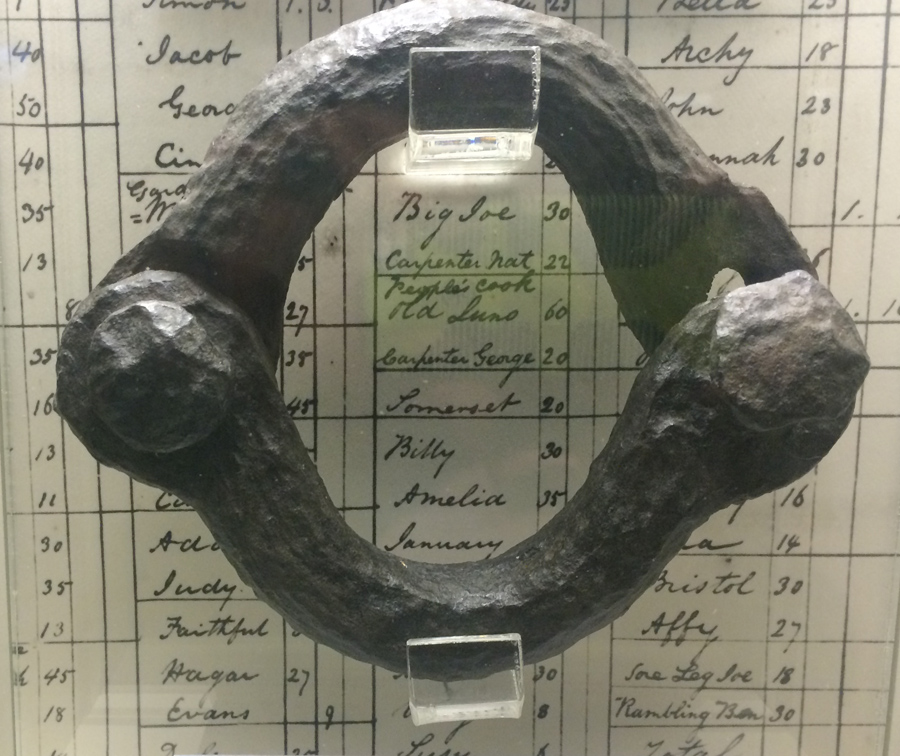
manacle

paper piece revealing what must be the name of one of Eliza's sons paper piece revealing what must be the name of one of Eliza’s sons, Charles Cotesworth Pinckney

gratitude and slavery

“If the only prayer you say in your entire life is ‘thank you’, it would be enough.”   
Meister Eckhart.

IMG_9153That shell and that driftwood came from Sullivan’s Island, SC. On the beach, which oddly reminded me very much of Martha’s Vineyard, I could look out to the east, knowing that Africa lay beyond the horizon. I wondered how many ‘recent slave imports’ did exactly that. I wondered what mix of bewilderment, rage, defeat, and sadness they might have felt. I acknowledged how little idea they had of what lay ahead.

Sullivan’s Island is where captives coming into the port of Charleston were quarantined for a few weeks before being taken to the auction block. During the very busy slave importation years of  the 18th century yellow fever, malaria, and small pox repeatedly and vengefully swept through the lowcountry. Any slave sick enough to die within the quarantine period was allowed to do so. It is heartrending to learn that a ten percent loss of cargo (read: African life) was deemed an acceptable margin in the slave trading business.
sullivan-islandWith the obvious aim of fattening them up for sale, the Africans were fed better during quarantine than at any time during the Middle Passage. They were groomed, oiled, and if plagued by dysentery (but not sick enough to die), plugged up temporarily with whittled corn cobs. If punished, they were paddled rather than whipped, for welts on the back signaled a wayward, unmanageable African, and would reduce his value on the block. There are reports of the sailors miming monkeys scratching their underarms to get the Africans to wash themselves. There isn’t much you can read about this island’s history without feeling sick.

There is no memorial.  Toni Morrison saw to changing that. See images of the Memorial Bench here.  [Update: just learned on a website called African American Charleston that in 1999, “On July 3, a 6-foot historical marker is placed on Sullivan’s Island near Fort Moultrie to honor those enslaved Africans who arrived in bondage via Charleston Harbor.”]

Right before I went to this trip to SC, I heard a sliver of coverage about how much slaves contributed to the building of the ivy league schools in the Northeast. Maybe it was a review of the following book by Craig Steven Wilder, Ebony and Ivory: Race, Slavery, & the Troubled History of America’s Universities:

Many of America’s revered colleges and universities—from Harvard, Yale, and Princeton to Rutgers, Williams College, and UNC—were soaked in the sweat, the tears, and sometimes the blood of people of color. The earliest academies proclaimed their mission to Christianize the savages of North America, and played a key role in white conquest. Later, the slave economy and higher education grew up together, each nurturing the other. Slavery funded colleges, built campuses, and paid the wages of professors. Enslaved Americans waited on faculty and students; academic leaders aggressively courted the support of slave owners and slave traders. Significantly, as Wilder shows, our leading universities, dependent on human bondage, became breeding grounds for the racist ideas that sustained them.

[from the Amazon page selling his book].

IMG_2454 renovated slave shack, Magnolia Plantation

So — for the beautiful quads that populate this neck of the woods, with their stone edifices, filigreed ironworks, brick walkways, and carved doors: thank you to the enslaved, skilled laborers. Thank you.

It sounds lame, the previous paragraph, but how much MORE lame would it be never to say thank you, never to acknowledge the contributions made? I am deciding to trust Meister Eckhart on this one.

Sweetgrass baskets

IMG_8160Meet Rose Marie Manigault, basket-maker extraordinaire.  She is holding the basket that I purchased from her at Magnolia Plantation, near Charleston, SC. There is so much to say about her work and methods and presence, but let me start by directing your attention to the poking tool in the basket on her lap.  It is a utensil (spoon? fork?) with the utilitarian end removed and the remaining stem blunted. Thinking about all the harm I do to myself while quilting, I asked if her fingers were calloused.  She said “no”.
IMG_8895As I watched her work, it was clear why she found my question puzzling (maybe it was just weirdly personal). She poked and tugged and wrapped with deft skill — no fingers harmed! Look at those incredible pine needle knots!

Her wares were lined up on a high table set up under a pergola draped with wisteria. It was a little too early in the season for the vine to be in bloom, but it couldn’t have been a prettier site — especially dovetailing, as the time did, with a horribly raw week in Boston.

IMG_8161Look at the variety! That central, smallish basket in the foreground is a pattern called “Elephant Ears”.  I learned that the baskets darken with age and that sweetgrass, once abundant, is becoming harder to procure.  Unlike osier and other basket-making materials, sweetgrass, palmetto, and pine needles require no soaking to render them pliable.

Many beautiful examples of African American basketry are collected in the Lowcountry Digital Library.  The knowledge about how to weave fanner baskets and employ them to winnow rice were two of the many African skills that allowed planters to amass fortunes growing rice with slave labor. The fanner basket below, is at the Charleston Museum, and is made of bulrush.
IMG_2499Here are a few more examples of baskets at the Museum.
IMG_2516 IMG_2517Ms. Manigault was kind enough to pose for my pictures and sign the bottom of my basket. Anyone presuming to take her picture without making a purchase was shoo’d away.  As a crafter (even absent issues of race), I could relate to this.
IMG_8896I haven’t quite found the right place for my basket yet.  But I will.  And it will be used.
IMG_8862  IMG_9156IMG_2440 IMG_8165IMG_8897Here is a link to Magnolia Plantation. I could not find a single reference, pictorial or otherwise, to Ms. Manigault or her baskets. Can anyone else?!!


White privilege is an invisible thing

buttons-and-lace

My father, born in Fort Lee, NJ, raised in Queens, NY. Of Irish descent.

I have been wondering how to think about white privilege — how to acknowledge it, understand its parameters, and to notice the profound consequences of it in my life. It seems like the least I can do to honor Trayvon Martin. It strikes me as a more fitting tribute than wearing a hoodie to a rally.

Of course, wearing a hoodie to a rally is another way to express one’s grief at this shameful episode in American life and I’m glad that white people all over the country are doing as much. But one of the very first things to occur to me this week about racial privilege is that, in terms of the perception of menace, it doesn’t MATTER what I wear, or more to the point, what my 17 or 19 year old sons wear.

by-the-charlesHad my 17 year old been wearing a hoodie and acted in all the same ways as young Trayvon, either:  A) he’d still be alive, or B) Zimmerman would be in jail.  Further, if he HAD been shot and killed, the Stand Your Ground Rule would be dismantled in short order.

I was away during the trial and on a media fast, so I missed most of it, but I gather that the prosecution bungled the case pretty badly (perhaps the most obvious blunder being — AN ALL WHITE JURY, REALLY?!!)  A friend who is a criminal trial junkie (her term, not mine) stated it this way: “It was like watching a beloved sports team blowing it, over and over.”

Putting aside the nuances and complexities that populate most criminal trials, it is absolutely the case that there is real cause for outrage. And grief. And alarm. The Esquire piece by Charlie Pierce expresses that outrage clearly and poetically.

neworleans postcard

2005 – from Katrina series – “I am an American citizen”

What I have come up with regarding white privilege is only a threshold insight. It is this — when a cultural understanding is so assumed, so ingrained, and so supported by institutions, left and right, it becomes invisible. Part of the privilege of being a white American, then, is that my status requires no tending, examining, defending, or justifying.

2005 - Katrina series, close up

2005 – Katrina series, close up from another quilt

Put simply, one of the primary benefits of white privilege is not HAVING to think about race. What African American in this country has spent a single day of their lives similarly situated?

flower-of-youthWith all of this in mind, I started another White House quilt this week.

As some of you know, the White House quilt made earlier in the summer was, perhaps, about overcoming personal history — with white standing in for a state of peace or the absence of struggle.  And when I added a red thread, it became about protecting personal space.

The white in the White House quilt I’m making this week signifies a house in a protected, privileged, and not-necessarily Southern neighborhood. And the red signifies blood.

I placed red African fabric and a piece of a red floral handkerchief at the base of the white house — to represent the felling of a young African American in the flower of his youth — precisely because of his relationship to whiteness.  I built up the surrounding mantle with sections previously pieced (last summer) for one of the Middle Passage quilts.

white-house-and-middle-passage

White House, Blood, and Middle Passage

This really broke my heart. And here’s why.

Last summer, pairing up fabrics that represented African life in its sunny, beautiful, integrity with those that represented slave ships, ocean passage, and fragmentation of life, identity and culture, I thought of the Middle Passage, and even slavery, as history.

But the killing of Trayvon Martin and the subsequent acquittal of George Zimmerman and the willingness to leave the Stand Your Ground Rule on the books, prove that slavery resides on a spectrum in this great land of ours, and that it’s not over yet. It is not over yet.

Any black person could have told me this.*

* As if to illustrate this point, reader Wendy sent this link in a comment below… It is a tour of Sanford, FL (where Zimmerman killed Trayvon) with a local African American and a visiting Canadian journalist. The tour guide tells of the long history of racism specific to and still-in-living memory of his town — including the lynching of his uncle for whistling at a white woman.  It is well worth the eight minutes viewing time.