
quilt on quilt

Poppy Script piece gets a house

watching Ken Burns’ series on the dust bowl – can you tell?

house reduced to its seams

backlit house

holiday houses

quilt on quilt
Poppy Script piece gets a house
watching Ken Burns’ series on the dust bowl – can you tell?
house reduced to its seams
backlit house
holiday houses
 Each Thursday, I sit with a group of women and spill out writing under the tutelage of a teacher trained in the Amherst Writing Method as developed by Pat Schneider.
One of the key elements of this method is that all comments must refer to the ‘narrator’. Even if a participant writes in the first person — the rule holds. Is this a reliable narrator? A sympathetic character? Is she holding back, or giving us lots of details? If a participant strays, and refers to ‘you’ or directs queries suggestive of the assumption that the writer is the narrator, our fearless leader corrects course. “You mean the narrator…”
Why so important, you might ask?
Freedom, pure and simple. Afterall, our writing session is not therapy and it is not a support group. Not that we are impersonal with one another — not at all. But it is nevertheless the case that even with pledged confidentiality, the protection of writing as a narrator is essential for creative flow. It is actually a profound freedom.
In that spirit, I am working on letting cloth tell a dark story.
Here, where there IS no confidentiality, I am trusting my readers to hold the story of the cloth as if we were all trained in the Amherst Method. In other words, I hope you ask yourself, “is this quilt successfully depicting trauma?” rather than, “good lord, what happened to you?!!”
At the ripe age of 55, I have come to believe that although we are each born with certain gifts and certain curses, and that they shape our thoughts and feelings in profound ways, on some level the details REALLY DON’T MATTER.
And so, I begin a house quilt where the symbol is not Security, Safety, and Solace, but rather a place of upset and fear. I started with a simple muslin construct. I pieced it to a ground and sky, because I wanted it to retain some sense of place once I started cutting it up. I free-pieced some red fabrics that would be revealed when I cut open ‘windows’ and ‘doors’ in the house structure. This all happened in the span of an afternoon. A very sunny day before Thanksgiving.
 It was hard to stay the course on cutting, and in retrospect, I wish I had left the rest of the roof intact.
 Even though I wanted the idea to include that the outer and the inner are severely mismatched, I like the way the red trunk points downward to the linen/green branch of the foreground.
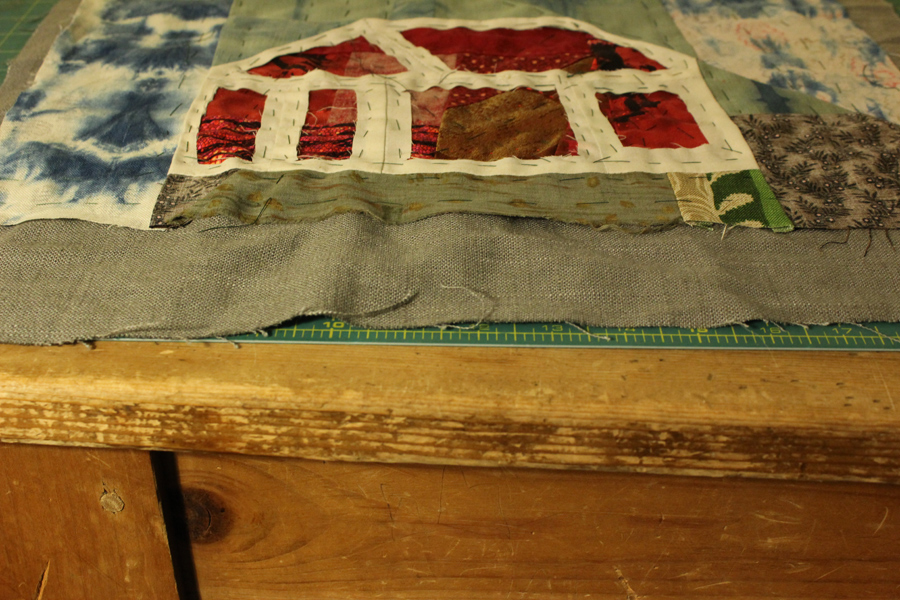 I used a dark green thread to baste the house, the red under sections, and a swath of grey linen together, and the minute I started doing more detailed stitching, I regretted that. The threads get in the way and I am spending a lot of time cutting and removing them. Not sure, now, why I opted NOT to use Jude Hill‘s invisible basting method.
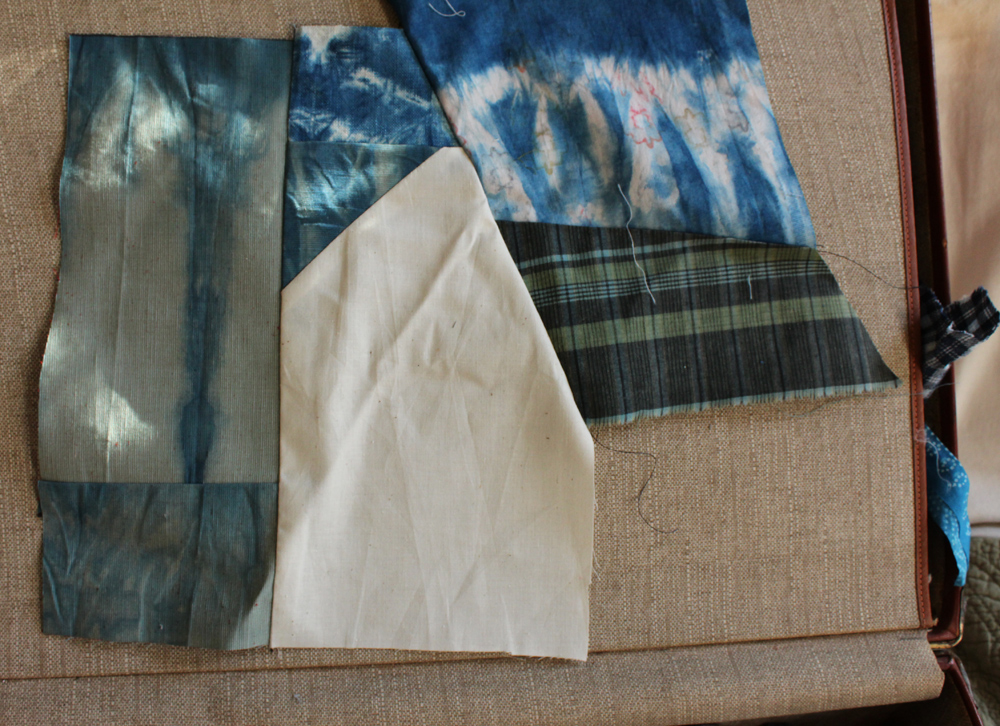 I had gotten a little lost for awhile with THIS detour (above)… and forced myself to return back to basics, then making the muslin house of the other photos. Funny thing, though, when I laid the above-scrap over the basted quilt-in-progress, I found I liked it a lot more.
 Not sure what I will do about that – if anything. I plan to keep stitching the existing layers together, and then I’ll see. The other little surprise, which goes to content here, is the appearance of an Indigo Angel. I had absolutely no plan to address healing or grace or serendipity with the piece, and yet, as is so often the case, the quilt had other ideas.
 There she is, clear as clear can be (she even has feet, which you can’t see in this picture) – fluttering her wings next to a heart-shaped face!
It is hard to think about anything but the election or the Nor ‘Easter rambling up the coast, but before too much more time goes by, I wanted to catch up my dear readers on the the Middle Passage quilt experiments. You may recall “Middle Passage I” after its first dunk in the indigo vat:
 It looked more like blue fog than rising water, so I dunked the entire bottom half. But first, I used corn syrup as a resist. I slathered it on with a paint brush, hoping to preserve some of the color of the floral green shapes, the green hut, the turtle, and a few of the red stripes of the batik.
 The corn syrup worked as a resist, but it will take some quilting to make it ‘work’ as a visual treatment. And maybe it won’t. We’ll see. Not sure what the sugars did, if anything, to the indigo vat.
 The back shows how much dye the quilt has absorbed. Some dye landed on the upper green/white linen area by accident, so with a paint brush I applied more dye just to the surface (techniques learned in Glennis Dolce’s Indigo Class). I also shadowed the edge of the moon with indigo.

 Last week my fingers turned blue while quilting those floral green areas and the turtle. And, I was disappointed with what the stitching accomplished. Between the transfer of dye to my fingers and the presence of batik (notoriously difficult to poke a needle through), I may opt to draw with thread on one of my machines.
Also, it occurred to me that if this quilt is to live on someone’s wall in the future, it will need to be backed with fresh cloth, because I think the dye would transfer to the wall as well. Maybe I could rinse in vinegar? Then wash in soap and water? I did this for the first time with one of the rectangular pieces of linen that I hemmed into a scarf. Not a trace of blue came out in the rinse, which means success – I think!
I am prepared to be disappointed with these experiments. It is the very nature of an experiment that the outcome is unknown. In a way, every quilt is an experiment. But, sometimes we add new techniques or color choices that scramble things more than usual. If this one bombs, I will cut it up and try to use the pieces in another way.
What do YOU do with failed experiments? And, how do you talk to yourself while trying something utterly new and possibly terrible looking?
My thoughts and prayers are with the folks in NYC and NJ and elsewhere, suffering with clean up, destruction, and deprivation. I hope temperatures stay mild. It’s gotten a little cold here (outside of Boston) in the last couple of hours. Here is one of the Berkshire barns, as of this morning. It is a completed quilt top.

I’m not sure why it turned out to be such a struggle to assemble, but it was. It’s about 32″ wide and incorporates some of the more successful indigo cloths from this summer. The indigo worked particularly well for the mountains. I’m calling it, “Waiting for Snow”.
I created a ‘side bar’ quilt on the work table, taking little breaks from the Barn. It has a totally different feel, and therefore constituted a visual contrast. This was refreshing for some reason.
 In this one, the structure is merely hinted at, and the landscape has been granted license to be wild and dominant. Not a surprising choice, given the rampaging punches that Sandy delivered over the weekend, while I was safely working down in my cellar studio. This composition features some more of my indigo dips, as well as silk from my upholstery-design-contact, quilting cottons, batiks, and that Lonni Rossi broccoli/tree fabric that I so love.
 I am hand quilting this little composition today, as the sky greys and a cold rain starts to fall. Its working title is: “Long Island Blues” (Jude Hill online class project). In this case, the usual horizon line has been broken up (submerged?!!) by the wandering watery lines of shibori.
 It is possible that I am making the same quilt over and over again.
 Oh look, there’s another blue moon! And — surprise! — another hut, with its two-toned roof angled skyward.
 And, my goodness — two in a week!! — ANOTHER two-toned roof and ANOTHER moon — stitched together!
 Leave it to a Buddhist to address the matter of repetition with eloquence. Gary Snyder:
Repetition and ritual and their good results come in many forms. Changing the filter, wiping noses, going to meetings, picking up around the house, washing dishes, checking the dipstick — don’t let yourself think these are distracting you from your more serious pursuits. Such a round of chores is not a set of difficulties we hope to escape from so that we may do our ‘practice’ – which will put us on a ‘path’ – it IS our path… The truly experienced person, the refined person, DELIGHTS IN THE ORDINARY. Such a person will find the tedious work around the house or office as full of challenge and play as any metaphor of mountaineering might suggest…. One goes out onto the ‘trail that cannot be followed’ which leads everywhere and nowhere, a limitless fabric of possibilities, elegant variations a millionfold on the same themes, yet each point unique.
From, The Practice of the Wild.
Here is a peak at what I really think about this latest Moon Hut quilt (depicted with my feet above).
I make the sky out of a linen so soft it begs to be touched. The swirls on it suggest wind to me, and are a green I struggle to name – sea foam? Moss? The dragging of thread along some of the swirls pleases me, accentuating their drama and direction, providing a welcome counterpoint to yammering, televised heads debating Medicare’s future. The orange leaves and red leaves play off of each other, and provide a feathery sense of movement, and a nod to the incomparable work of Jude Hill, who explores feathers and wings this season. The moons of the foreground place sky into the ground – a kind of reversal that also pleases me. There’s even a little redemption here – for I am making use of a fragment from a barn quilt that couldn’t find a place until it landed here. How can all of this not be (to quote another icon) a ‘good thing’?!!
Today I will practice thinking about these hut and moon quilts as “elegant variations” – which I already know to be true, if I am honest, if I stay away from over-thinking, if I flick doubt away like a pesky gnat, denying it purchase. That’s a practice, too – flicking doubt away like a pesky gnat, denying it purchase.
Where pleasure resides, repetition is no effort at all.