Tag Archives: Eliza Lucas Pinckney

Adding light, revising novel

I’m adding light and shadow to appliqued hawk. Made her head lighter and used white poly for beak to make it pop. A scrap of fabric practically fell out of the basket and felt like a minor show of Providence.

Jude had the idea over on Instagram to darken some of the ripples around the hawk’s head. Since I like the way it adds a sense of motion, I may continue around the body as long as I have that color thread. It’ll look good flowing off the wings.

Had some gross polyester swirled with black in that basket, too. Added to tail and wings for more contrast. Light. Maybe you can see a difference with earlier incarnation, maybe not (below).

It’s nice to have company.

In the meantime, I finally talked to my paid manuscript consultant yesterday. Round three coming up. I know I’ve said this before but it bears repeating, perhaps even shouting off the rooftops: SHE LOVES MY BOOK.

I think people forget how solitary a process writing is.

House names should not be italicized. If I’m gonna talk about the elder Middletons toward the end, they need to be introduced earlier. Still sags here and there — needs tightening. Not so many descriptions of clouds, perhaps. Maybe not so much about Melody’s first owner. Explain what head rights are and how to memorialize land in Author’s Note, which starts like this:

When I began this novel, Trayvon Martin was alive and as I finished the second edit, George Floyd was dead.

The suggestion that I add an epilogue (say in 1758 after Eliza and Charles Pinckney return from a five year stay in England), will take a little more thought. That’s fourteen years after my original end. Lots of years I haven’t thought about all that much.

A six year time frame (1738 to 1744) allowed a laser-like focus. Etiquette in 1720? I don’t care! Rice markets in 1750? Also don’t care. Now I need to care. I’ll start with Eliza’s letters.

A walk with temps in the 40’s was cause for celebration this week. Daffodils shoving aside leaf debris. Snow shrugging off the curbs. It won’t be long now ’til the miracle of hyacinths.

In the meantime I am trying to answer the question (Acey’s): how do you hold your heart? Or maybe just asking it. Softly.

The collage challenge with Paris Collage Collective continues. This week: Shirley Chisholm.

More to come. I want to cut up seed catalogues and wreathe her head with flowers. In the collage above, the headstone of Harriett Jacobs served as reference to the long history of oppression, Jacobs being another Black woman who overcame so much.

Names of the enslaved in Eliza Lucas Pinckney’s will

In the spirit of ‘saying their names,’ the names of the enslaved “property” in Eliza Lucas Pinckney’s estate are listed below. Black people were enumerated in testamentary documents along with furniture, horses and mules, jewelry and land, making clear their status as chattel.

[The names listed in bold below are names I’ve used in my novel, The Weight of Cloth, published 9/24].

It’s also worth noting that at the time of her marriage to Charles Pinckney (May 27, 1744), Eliza’s father included about two dozen enslaved people as part of her dowry. The record tells us that Quashee (aka John Williams) was a matter of dispute between Eliza’s father and her fiance. Both men wanted him and for good reason — he was literate and an extraordinarily skilled carpenter. Eliza’s husband-to-be won out and Quashee went on to oversee and help build the newlywed couple’s new home on East Bay.

To read more about the fascinating life of Quashee, who after Charles Pinckney freed him went on to amass a fair amount of property, including slaves. At some point, he vanished from the record (my theory being he became too successful for whites to tolerate). Please see Andrea Feeser’s book, Red, White, and Black Makes Blue / Indigo in the Fabric of Colonial South Carolina Life.

Also note: it’s a mistake to think that slaves named after days of the week or months were so-named out of a heartless, objectifying inattention on the part of auctioneers and owners, much like some names were based on slave trading ships (see recent post about Phillis Wheatley). In some African cultures it was common. For instance, Cudjoe (variants: Cuffy, Joe) means Monday; Quashee, Sunday.

Hercules – slave

· Abraham – slave

· Monday – slave

· Barack – slave

· Juno – slave

· Betty – slave

· Jim – slave

· Frank – slave

· Mary – slave

· Tyrah – slave

· Smart – slave

· Elsey – slave

· Serah – slave

· Solomonslave

· Prince – slave

· Hanay – slave

· Rachel – slave

· Mary – slave

· Jacob – slave

· York – slave

· Fortune – slave

· Doll – slave

· Joe – slave

· York – slave

· Celia – slave

· Daphne – slave

· Joe – slave

· Cuffy – slave

· Susan – slave

· Lucy – slave

· Elsey – slave

· Milly – slave

· Peggy – slave

· Ned – slave

· Binah – slave

· Peggy – slave

· Rose – slave

· Juno – slave

· Joe – slave

· Henry – slave

· Jenny – slave

· Thomas – slave

· Jacob – slave

· Bella – slave

· Betty – slave

· Hercules – slave

· Nelly – slave

· Betsy – slave

· Pindar – slave

· Caty – slave

· Pendar – slave

· Juno Henry – slave

· Harry – slave

· Ann – slave

· Pendar – slave

· Grace – slave

· Johnny – slave

· Joshua – slave

· Tenah – slave

· Nathan – slave

· Jack – slave

· Stephen – slave

· Bess – slave

· Ceasar – slave

· Robin – slave

· Adam – slave

· Binah – slave

· Caty – slave

· Sue – slave

· Cudjoe – slave

· Doll – slave

· Hannah – slave

· Dublin – slave

· Charity – slave

· Lucy – slave

· Grace – slave

· Prince – slave

· Sarah – slave

· Frank – slave

· Harriett – slave

· Abraham – slave

· Raleigh – slave

· Celia – slave

· Coleman – slave

· Ishremael – slave

· Polly – slave

· Ishramel – slave

· Henry – slave

· Gibbe – slave

· Meene – slave

· Ellen – slave

· Bella – slave

· Maria – slave

· Gilbert – slave

Added by Lowcountry Africana · July 4, 2010

PS photo was taken at Boone Hall Plantation.

Erasure Poems

1). Start with a source document. Mine is a letter written in 1740 by Eliza Lucas Pinckney to her father.

2). Black out some words (or select some) or both.

3). Type up and read, edit if desired.

4). Repeat. Enjoy the variations.

I followed two rules: 1) all words in the Erasure Poem must be in the order that they appear in the source document and 2) all words must remain in their original form (i.e. the same tense or person). I made an exception to rule two and updated archaic spellings.

This technique, very popular in altered book circles, is one I’ve used for collage, but never for poetry. Relative to the historic fiction I’m writing (Eliza is one of the main characters), I was curious what might be revealed — anything new or useful about Eliza or her circumstances?

All of this was inspired by a poetry reading a few weeks back at Sam Durant‘s “The Meeting House” in Concord, Mass. (an Arts and the Landscape event sponsored by Trustees of Reservations). Four poets read. One of them was 2015 National Book Award winner for Poetry, Robin Coste Lewis (pictured above), who offered an erasure piece. It was intensely moving (you can hear her read three of her poems, here).

Letter from Eliza
to her Father, 1740
ONE

Honorable Sir,

Words to express the situation
beyond expression

the fearful immediate
danger

as I must own some
advantages
such as honor, perhaps profit too.

Put in with my just cause
the love you avoid
by unjust means.

The assurance that this life
depends on Dear Sir,
you.

Injurious to imagine
Heroism.

I deserve
this time.

You always persevere
Honorable Sir.

Your Daughter

***

Letter from Eliza
to her Father, 1740
TWO

To Colonel,

I want words
from you.

The situation terrifies us.
Immediate danger.
I must own

You are sensible.

Might some advantages arise
such as honor, profit too,
mere trifles
in the balance?

A just cause in preference
to every other means.
Courage enough
to will the thought
unworthy of you.

To pretend to Heroism
should conceal fears

and affections.

Always prayer.

Your most obedient
Daughter

***

Letter from Eliza
to her Father, 1740
THREE

To Sir,

I want words under you, us
Beyond and increased

Some place to differ

There, when put in the balance

Life
A just cause
Love

You avoid the assurance
that this welfare
injurious, I deserve.

To pretend
Heroism, I conceal
perpetual apprehensions.

I am always the prayer.

Your Eliza

***

Letter from Eliza
to her Father, 1740
FOUR

I am sensible and
I esteem the fight
as well as the love

Advantages arise

These mere trifles
honored a just cause
as well as every means
to retract anything more
than I deserve.

Mama and the Almighty
The constant prayer

Your obedient Eliza

Blood and Indigo — the great reveal

photo of photo in the Charleston Museum photo of photo in the Charleston Museum

Blood and Indigo was the working title for my novel taking place in the mid-eighteenth century in South Carolina. (Settled later on The Weight of Cloth). I wasn’t planning to be so open about the project yet (though I am now more than two years into it), but there is an indigo workshop in September just outside of Charleston and I’m planning to go.

IMG_2461I traveled to Charleston this past April, as some of you know, but was only there for a short while. I took tons of pictures and did two plantation tours and visited the Chalmers Street former slave auction site and spent two afternoons in the Charleston Museum,  but this next trip would be fabulous — I’d get to see the area in the fall (and take tons more pictures) and the indigo! Well, check out Sea Island Indigo

IMG_2454It all started with a book by India Flint called “Eco Colour”.  In it, she devotes a page to the colonial settler, Eliza Lucas Pinckney, and her work with indigo.  Next I read Eliza’s letters. Once I started asking myself, ‘what were the lives of her slaves like?’ I was off and running.

from my indigo vat, 2012 from my indigo vat, 2012

For more than two years now, I have been writing and researching and have learned so much about American history that I feel like a different person than when I started out. Reading history about the enslaved is transformative. Details about the slave trade, the slave codes, the brutality, the labor practices, the attempts at rebellion, the words used by the elite to describe “their” African Americans — all change you.

The most recent thing I’ve read about racism was published in a recent issue of The Atlantic Monthly, and it’s called “The Case for Reparations”.  Written by Ta-Nehisi Coates, it is hard-hitting, full of examples of ongoing harm, and it will make you shake your head in sadness and wonder at what we are — we Americans, this America.

An African American crafter will be teaching rag quilting and talking about Gullah culture. I cannot wait.
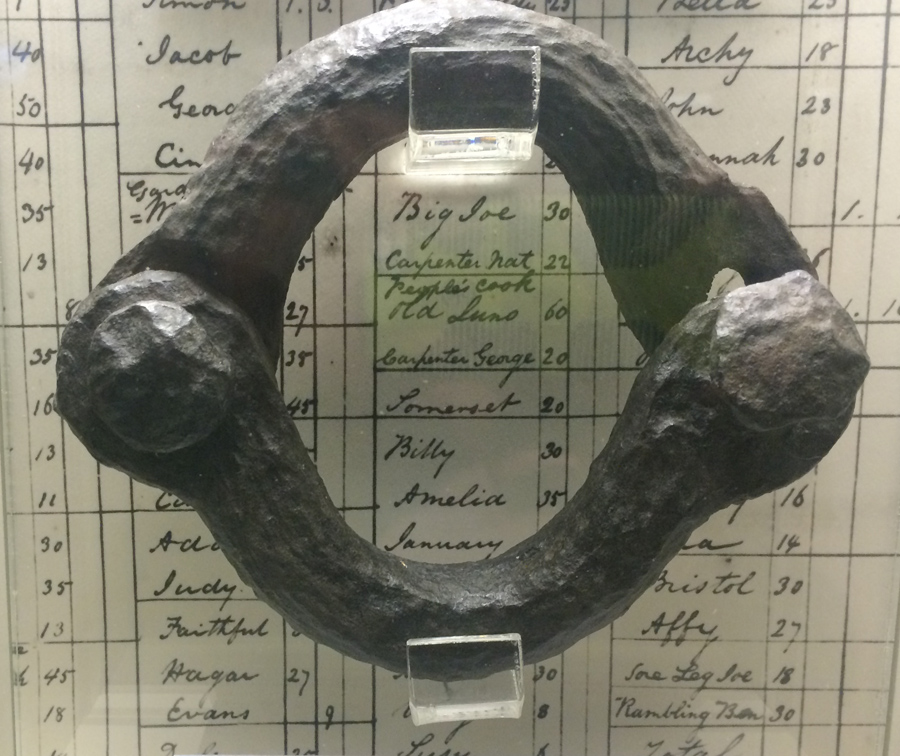
manacle

paper piece revealing what must be the name of one of Eliza's sons paper piece revealing what must be the name of one of Eliza’s sons, Charles Cotesworth Pinckney

The Textile Wing at the Charleston Museum

The textile wing of the Charleston Museum in South Carolina featured some beautiful quilts (mostly antique), garments from the colonial era on through to the 70’s, embellished accessories, and very intriguing notions.

IMG_2577

Embroidered Satin Bag, c. 1795. Attributed to Margaret Dick Burgess

IMG_2554 I didn’t know what ‘toilet pins’ were, so I looked them up.  An online draper called Merchant & Mills, gave me this tidbit:

…traditional toilet pins are an unusual pin being quite long at 45mm. Before the button became commonplace, many clothes were pinned together and a lady would have pins on her dressing table. The toilet pins come from and era when one would need pins for hats, corsage,etc. 

IMG_2580

Silk Embroidered Bag, from 1920’s

IMG_2560

Crib quilt, c. 1889. Log cabin variation made by Mary Louisa Schirmer Tiedeman

IMG_2566

incredibly small hexagons — dime-sized?

IMG_2565

“Field of Diamonds”, c. 1820. Maria Boyd Schulz

Don’t you just love the beautiful poking tools in the silk-lined box?IMG_2555 IMG_2563Paper pieced. More chintz. One of the names on the star below, “C.C. Pinckney” must refer to Charles Cotesworth Pinckney — one of Eliza Lucas Pinckney’s two sons.  Eliza Lucas Pinckney was a remarkable British settler who helped establish indigo as a crop and valuable commodity in the 1740’s. star-close

IMG_2572 IMG_2573 IMG_2574 IMG_2575These Civil War era fabrics must have faded some. I wonder what they looked like 200 years ago. I can’t imagine them appealing to me any more than they do at this saturation.

There was one contemporary quilt. IMG_2569

"Memphis Blues", 2000. Mary Alma Parker

“Memphis Blues”, 2000. Mary Alma Parker

I apologize for the blurriness of the pictures (better ones in this flickr set), but I hope you can see that the hexagons in this quilt are made to appear dimensional both through color/pattern choices and a willingness to let the surface ‘poof’ a little. The color of the surround was a deep and appealing blue, while the center panel of paper-pieced hexagons exuberantly combined prints. Notice, too, that in places one of the surrounding ‘petals’ does not match.  Sometimes the center color fades and blends with its ‘flower’ and other times the color selected practically pops off the quilt with contrast. Skillful blending of tone and color give the panel this lovely fluid feel, as the colors fade from dark to light to dark again.

I assumed looking at the work that its maker is African American. Why? Because of the title, the lively use of prints and the occasional departure from pattern (print mixes and departure from pattern being well-appreciated and documented signatures of the Gee’s Bend quilts, as well). Does anyone know? I couldn’t find anything online, even with a variety of search terms and approaches.  I DID learn that Parker is a very common name, as is “Mary Alma”.  Turning up various treasure troves of genealogy featuring white Parker families proves nothing one way or the other, of course, given that many slaves took their owners’ names once upon a time.